Key events in the domain of Command, Control, Computer, Communications and Intelligence for Homeland Defense and Homeland Security applications. Technology reviews, product insights, contract awards, news reports, and press releases.
Showing posts with label Area: Interoperability Exercises. Show all posts
February 22, 2012
French Army's FÉLIN digitized soldier system participates in a Franco-British live exercise
News Report
As announced by French Army and then reported by Defence-Aerospace, soldiers of the French 8th Marine Infantry Parachute Regiment (8th RPIMa) and soldiers of the UK 5th Battalion Royal Regiment of Scotland took part on Feb. 13-17 in a bilateral Franco-British Combined Arms Live Fire Exercise (CALFEX). During the event, French soldiers operated the new digitized soldier system Fantassin à Équipements et Liaisons Intégrées (FÉLIN). The system was tested under tactical conditions intended to closely reproduce those normally encountered on theaters of operation on which the French army is likely to be deployed.
The Technology
Sagem's FÉLIN (Fantassin à Équipements et Liaisons Intégrées) is an integrated soldier system designed to enhance all the dismounted soldier’s operational functions: protection, observation, C4I, weapons use, mobility and support. The system is customized into five configurations for different levels of command, with the standard configuration including a portable computer, a voice and data radio, new combat clothing with body armour and a new ballistic helmet.
The individual soldier system is equipped with a radio and a GPS. The system exploits a dedicated voice and data network that connects the individual soldier to other infantrymen in the section and to the section commander, who is connected to the vehicle battle management system (Sagem's SITEL). FÉLIN's tactical radio is the "VHF-over-IP" PR4G VS4 from Thales, which provides tactical internet connectivity and links the dismounted soldier to the vehicle's SITEL.
FÉLIN is one of the most studied soldier systems to date, in terms of integration. The French DGA (Délégation Générale pour L'Armement), Sagem and the French Army have worked to create something very close to the needs of the soldier in terms of ergonomics, integration and understanding the battlefield mission. Specifically, the DGA provided a target weight for the system of less than 25kg, to include the entire system, weapons, ammunitions, and 24-hour energy, food and water provisions. Effort was also directed to the selection of the energy supplies and the method of recharging batteries.
The Context
In 1996, the French French Ministry of Defence Procurement Agency (DGA, Délégation Générale pour L'Armement), placed a contract on an industrial team led by Thales for the development of a dismounted combatant equipment technology demonstrator (équipement du combattant débarqué) or FÉLIN. The system was tested over a two-year period from 1999 and 2001, when the DGA invited Sagem and an industrial team of Giat and Thales to carry out FÉLIN definition studies. The DGA selected Sagem as the preferred bidder in 2003 and awarded the FÉLIN V1 (version 1) contract in March 2004.
References: French Army (1), Defence-Aerospace (2), Defence-Talk (3), Army-Technology (4)
February 6, 2012
How U.S. Army is restructuring its modernization programs based on the NIE results
News Report
Here in this blog we have already discussed how the U.S. Army is using its Network Integration Evaluation (NIE) efforts, part of the Agile Acquisition Process, to force a shift from Research, Developmental, Technical and Engineering efforts to the procurement of mature network capability that will be fielded starting in 2013 (1,2). The year-old NIE has already driven decisions to send certain systems to the field, revamp others to better meet Soldier needs and terminate several programs that lacked merit, leading to significant cost savings and avoidance.
As reported by U.S. Army, much of the cost savings and avoidance stems from program adjustments made after NIE results prompted the U.S. Army to re-assess planned purchases or revise requirements. Examples include the cancellation of the Early Infantry Brigade Combat Team effort (including the Network Integration Kit) and the Mounted Soldier System program, and the restructure of the Nett Warrior and Joint Tactical Radio System Ground Mobile Radio efforts.
Industry participation in the NIE and the Agile Process is growing steadily, and more than 40 industry technologies will be included as part of NIE 12.2 in April-June.
Nett Warrior
Nett Warrior is the desendent of the U.S. Army’s Land Warrior program, which sought to provide soldiers with digital maps connected to a tactical data network and managed by a small computer. During the first NIE event in June 2011, U.S. soldiers deemed the system valuable but too bulky (it was weighting between eight to 10 pounds). U.S. Army leadership quickly restructured the Nett Warrior program to take advantage of the latest commercial technology. The lighter version unveiled at a press briefing in October 2011 weights three pounds and consists of a monocle to project battlefield maps and unit location data to the user, and what the service calls an End User Device connected to a Joint Tactical Radio System Rifleman Radio.
The slimmed-down version of Nett Warrior received positive reviews at NIE 12.1 in November 2011. This radical redesign was the result of post-NIE 12.1 U.S. Army's decision to trim many of the old features from the system. These changes yielded more than $800 million in cost avoidance and resulted in a more usable end product for the dismounted Soldier, to be delivered to more units on a faster timeline. "In the Nett Warrior situation, the formal requirement didn't match up with what users were saying they needed to get the job done," said Col. John Morrison, director of the Army G-3/5/7 LandWarNet-Battle Command Directorate. "The NIE gave us the opportunity to get the technology right, and to save significant time and money in the process."
Joint Tactical JTRS Ground Mobile Radio
Another major programmatic change related to the NIE is the termination of the Joint Tactical JTRS Ground Mobile Radio, or GMR. JTRS GMR is a software-programmable radio system providing secure, reliable, multi-channel voice, data, imagery and video communications for mobile military users. The system was expected to deliver networked communications on-the-move at the tactical edge supporting information sharing and combat readiness between service branches.
Soldiers at NIE 11.2 desired the GMR's communications potential but criticized its size, power consumption and startup time. When a decrease in the planned purchase quantity of GMR radios triggered a rise in unit cost and a subsequent Nunn McCurdy Breach, the Department of Defense decided not to re-certify the program, thus clearing a path for the U.S. Army to pursue lower cost, mature alternatives within the available radio market.
The U.S. Army is now using the Agile Process to procure a GMR replacement, known as the Mid-Tier Networking Vehicular Radio, or MNVR. This Non-Developmental Item, known as NDI, effort aims to procure available radios that transmit information using high bandwidth, non-proprietary waveforms such as Wideband Networking Waveform, or WNW, and Soldier Radio Waveform, or SRW, to move voice, video, data and images across the force in real time. The Army will leverage NIE 13.1 in the fall to test potential MNVR solutions and determine which will be fielded for Capability Set 14.
On November 2011, The U.S. Army issued a draft request for proposal for this system. Northrop Grumman and ITT Exelis have already teamed to compete for the U.S. Army's vehicle-mounted, software-defined radio, and proposed Northrop Grumman's Freedom 350 multifunction radio.
NIE 12.2
NIE 12.2 (scheduled for April-June 2012) will operate in a classified environment with secure data connections and will connect evaluation units to a higher-division headquarters, being represented by the 101st Airborne Division operating out of Fort Campbell, Ky. 2/1 AD operations at White Sands will require the brigade, battalion and company command posts to "jump" or move in uncooperative and unpredictable environments, and quickly establish network connectivity. A battalion-sized opposition force will be employed in dynamic scenarios with hybrid threats, including conventional forces, insurgents and members of the local population.
References: C4I Technology News (1,2), U.S. Army (3), DefenseSystems (4), MarketWatch (5)
Here in this blog we have already discussed how the U.S. Army is using its Network Integration Evaluation (NIE) efforts, part of the Agile Acquisition Process, to force a shift from Research, Developmental, Technical and Engineering efforts to the procurement of mature network capability that will be fielded starting in 2013 (1,2). The year-old NIE has already driven decisions to send certain systems to the field, revamp others to better meet Soldier needs and terminate several programs that lacked merit, leading to significant cost savings and avoidance.
As reported by U.S. Army, much of the cost savings and avoidance stems from program adjustments made after NIE results prompted the U.S. Army to re-assess planned purchases or revise requirements. Examples include the cancellation of the Early Infantry Brigade Combat Team effort (including the Network Integration Kit) and the Mounted Soldier System program, and the restructure of the Nett Warrior and Joint Tactical Radio System Ground Mobile Radio efforts.
Industry participation in the NIE and the Agile Process is growing steadily, and more than 40 industry technologies will be included as part of NIE 12.2 in April-June.
Nett Warrior
Nett Warrior is the desendent of the U.S. Army’s Land Warrior program, which sought to provide soldiers with digital maps connected to a tactical data network and managed by a small computer. During the first NIE event in June 2011, U.S. soldiers deemed the system valuable but too bulky (it was weighting between eight to 10 pounds). U.S. Army leadership quickly restructured the Nett Warrior program to take advantage of the latest commercial technology. The lighter version unveiled at a press briefing in October 2011 weights three pounds and consists of a monocle to project battlefield maps and unit location data to the user, and what the service calls an End User Device connected to a Joint Tactical Radio System Rifleman Radio.
The slimmed-down version of Nett Warrior received positive reviews at NIE 12.1 in November 2011. This radical redesign was the result of post-NIE 12.1 U.S. Army's decision to trim many of the old features from the system. These changes yielded more than $800 million in cost avoidance and resulted in a more usable end product for the dismounted Soldier, to be delivered to more units on a faster timeline. "In the Nett Warrior situation, the formal requirement didn't match up with what users were saying they needed to get the job done," said Col. John Morrison, director of the Army G-3/5/7 LandWarNet-Battle Command Directorate. "The NIE gave us the opportunity to get the technology right, and to save significant time and money in the process."
Joint Tactical JTRS Ground Mobile Radio
Another major programmatic change related to the NIE is the termination of the Joint Tactical JTRS Ground Mobile Radio, or GMR. JTRS GMR is a software-programmable radio system providing secure, reliable, multi-channel voice, data, imagery and video communications for mobile military users. The system was expected to deliver networked communications on-the-move at the tactical edge supporting information sharing and combat readiness between service branches.
Soldiers at NIE 11.2 desired the GMR's communications potential but criticized its size, power consumption and startup time. When a decrease in the planned purchase quantity of GMR radios triggered a rise in unit cost and a subsequent Nunn McCurdy Breach, the Department of Defense decided not to re-certify the program, thus clearing a path for the U.S. Army to pursue lower cost, mature alternatives within the available radio market.
The U.S. Army is now using the Agile Process to procure a GMR replacement, known as the Mid-Tier Networking Vehicular Radio, or MNVR. This Non-Developmental Item, known as NDI, effort aims to procure available radios that transmit information using high bandwidth, non-proprietary waveforms such as Wideband Networking Waveform, or WNW, and Soldier Radio Waveform, or SRW, to move voice, video, data and images across the force in real time. The Army will leverage NIE 13.1 in the fall to test potential MNVR solutions and determine which will be fielded for Capability Set 14.
On November 2011, The U.S. Army issued a draft request for proposal for this system. Northrop Grumman and ITT Exelis have already teamed to compete for the U.S. Army's vehicle-mounted, software-defined radio, and proposed Northrop Grumman's Freedom 350 multifunction radio.
NIE 12.2
NIE 12.2 (scheduled for April-June 2012) will operate in a classified environment with secure data connections and will connect evaluation units to a higher-division headquarters, being represented by the 101st Airborne Division operating out of Fort Campbell, Ky. 2/1 AD operations at White Sands will require the brigade, battalion and company command posts to "jump" or move in uncooperative and unpredictable environments, and quickly establish network connectivity. A battalion-sized opposition force will be employed in dynamic scenarios with hybrid threats, including conventional forces, insurgents and members of the local population.
References: C4I Technology News (1,2), U.S. Army (3), DefenseSystems (4), MarketWatch (5)
January 31, 2012
Combined Endeavor 2012: let the planning begin
News Report
As reported by U.S. European Command's web-site, the week-long initial planning conference in Slovak Republic for the exercise Combined Endeavor 2012 (CE12) began yesterday with more than 250 participants attending to begin planning.
Combined Endeavor is the largest Command, Control, Communications and Computers (C4) interoperability event in the world: over than 1000 communications professionals from 40 NATO, Partnership for Peace (PfP), and strategic security partners gather at a main operating base, a virtual forward site, and at multiple home stations supporting live troop movements and training via HF and/or a satellite backlink to conduct a series of operationally focused interoperability tests. Combined Endeavor prepares nations to collaborate, plan, and execute complex C4 systems in crisis response and combat operations. The exercise builds partnerships for regional and global operations between nations using communication and network systems, using both NATO and commercial standards to increase interoperability between nations.
Combined Endeavor is a U.S. European Command (EUCOM)-sponsored multinational initiative. The exercise has grown to be one of the main vehicles to demonstrate and propagate new interoperability concepts between NATO and Partnership for Peace (PfP) nations. Its primary focus is interoperability testing of C4 systems and identification and documentation of problems hindering interoperability. The secondary focus is to develop long-range action plans that result in the achievement of increased levels of interoperability among NATO and the PfP nations.
In 2011, the Italian Army deployed the core network for Combined Endeavor, supporting more than 35 countries participating in the exercise, that was held in Grafenwoehr, Germany.
Comments
Lt. Col. Brian Heberlie, CE12’s exercise director, reiterated the importance of CE at the opening ceremony of the meeting in the Slovak Republic. “The planning is always the hardest part and, if we are successful here, we’ll have another challenging and successful exercise next fall. It’s important to remember as we start the work this week that Combined Endeavor is not only about conducting the technical planning and testing, but, just as importantly, the creation of new partnerships and friendships while strengthening those that already exist. It is the human interoperability piece that truly ensures the work will get done.”
References: U.S. European Command (1), GlobalSecurity.org (2), Combined Endeavor (3), dvids (4)
January 30, 2012
U.S. and French Navy conduct interoperability tests in preparation of next Bold Alligator Exercise 2012
News Report
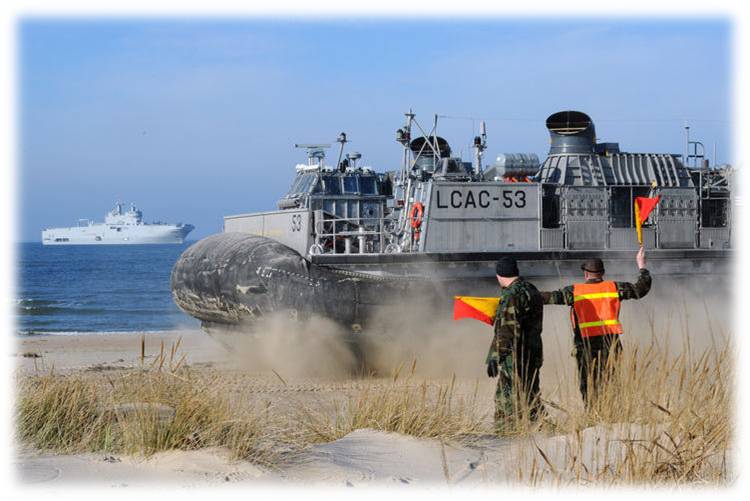
As illustrated in a recent news release, a naval interoperability exercise between the United States and France (which are NATO Allies) took place on January 25th and 26th on the beaches of Fort Story in Virginia Beach, U.S.A. The rehearsal exercise was conducted in preparations for the next multi-national amphibious exercise Bold Alligator Exercise 2012 that will take place in Camp Lejeune, North Carolina, U.S.A., involving the navies of the U.S., Australia, Canada, France, Italy, Netherlands, New Zealand, Spain and the United Kingdom.
During the exercise, Assault Craft Unit Four (ACU4) Sailors trained with the crew of French Projection and Command ship (BPC) FS Mistral (L9013).
![]() |
| U.S. Navy Landing Craft Air Cushion (LCAC) Vehicle from Assault Craft Unit Four (ACU-4) |
![]() |
| French Navy FS MISTRAL L9013 |
Exercise Bold Alligator 2012 (BA12) is expected revitalize U.S. Navy and Marine Corps amphibious expeditionary tactics, techniques and procedures, and reinvigorate its culture of conducting combined Navy and Marine Corps operations from the sea. BA12 will be a live and synthetic, scenario-driven, simulation-supported exercise designed to train Expeditionary Strike Group 2 (ESG 2), 2d Marine Expeditionary Brigade (2d MEB) and Carrier Strike Group 12. Staffs will plan and execute a MEB-sized amphibious assault from a seabase in a medium land-and-maritime threat environment to improve naval amphibious core competencies.
The exercise will run Jan. 30 through Feb. 12, ashore and afloat, in and off the coasts of Virginia, North Carolina and Florida
The Context
The numerous opportunities created by the U.S. and French armed forces through exchange programs, permanent sharing and exercises like Bold Alligator 2012 represent the very foundation of the many bilateral partnerships between NATO Nations. The Bold Alligator Exercise, although not a NATO exercise, is an example of how NATO Nations like the U.S. and France can work together to enhance interoperability and to strengthen the Trans-Atlantic link.
A bilateral exercise of this nature serves as a major contributor to Lessons Learned for all Allied nations. It is an opportunity to observe how exercises and operations are conducted while determining best practices and what works well between two national forces. All exercises between NATO nations, whether in a NATO context or not, are valuable to enhancing interoperability skills and capabilities.
Old con-ops will be studied and validated or dismissed in favor of new lessons learned. Ships planes and weapon systems currently in the fleet will be employed. New advances in command and control will be looked at and vetted.
Comments
"We have worked with the French navy not only here, but also in Toulon, France, to ensure our landing craft and the Mistral's well deck are compatible," said Capt. Mike Ott, ACU4 commanding officer. "This exercise today is the culmination of that planning and work we did overseas."
"This provides the opportunity to ensure that both the French and U.S. sailors understand differences in the crafts and can adapt correctly to them, so we can execute any mission safely," said Ott. "It is critical that we are able to conduct these operations, so that at any time and place in the world we could join forces with our French allies for any operation, such as Operation Odyssey Dawn in Libya, with little warning and little preparation and be 100 percent combat ready in a very short time."
References: NATO (1), U.S. Navy (2,3), SLD (4)
Subscribe to:
Posts (Atom)