Key events in the domain of Command, Control, Computer, Communications and Intelligence for Homeland Defense and Homeland Security applications. Technology reviews, product insights, contract awards, news reports, and press releases.
Showing posts with label Country: Norway. Show all posts
December 1, 2011
Contract Award: Kongsberg to upgrade Norwegian Network-Centric Air Defence capabilities
News Report
As announced in a recent press release, Kongsberg has signed a 360 MNOK contract to deliver an upgrade of NASAMS air defence system to the Royal Norwegian Air Force. The NASAMS system is produced by Kognsberg and Raytheon, and the upgrade will be delivered within a 2-year timeframe. The upgrade consists of deliveries of new High Mobility Launchers for increased mobility, upgrade of the existing FDC Command & Control centres and associated training facilities.
The System
The Norwegian Advanced Surface to Air Missile System (NASAMS) is a Network Centric Medium Range Air Defence System providing multiple-simultaneous engagement and beyond visual range (BVR) capabilities, closely integrated and adapted to a Country’s adjacent weapons and command and control systems. The system is intended to protect facilities and other assets against airborne threats such as cruise missiles, fighter aircraft, helicopters and/or unmanned aerial vehicles (UAVs). The NASAMS employs legacy hardware associated to the proven HAWK air defense system and the AIM-120 AMRAAM missile, as well as new hardware and components. All in, NASAMS air defense system consists of radars linked in a network, command and control systems and launch pads for AMRAAM missiles.
A standard NASAMS unit has a modular design comprising a command post FDC, an active 3D radar AN/MPQ64F1 Sentinel, a passive electro-optic and infra-red sensor and a number of missile canister launchers with AMRAAM missiles.
Normally, four NASAMS units are netted in a battalion network. Each NASAMS battery consists of 3 or 4 fire distribution centers, 3 or 4 surveillance, acquisition, and tracking radar systems, 9 truck-mounted missile launchers with 6 AMRAAM missiles each, and 3 or 4 truck-mounted MSP 500 electro-optical sensor for visual target identification and raid size assessment. This configuration enables NASAMS to engage up to 54 targets simultaneously within a few seconds.
The system is tied together with a uniquely designed ”hard-real-time” communication network to ensure minimum latency over large distances for maximum performance of the AMRAAM missile. This modular design permits mission oriented task force organization of NASAMS, allowing the operators to maximize the effect of the components and tailor the system to the task. The radar and launcher elements can be deployed over a large area separated by up to 25 kilometres, providing an extended coverage with few elements. Dispersed elements increase its survivability against enemy air and ground attacks.
The Context
Since its first introduction in Norway, another four countries in NATO and EU have acquired NASAMS. NASAMS is renowned for its use of the Raytheon AMRAAM missile, but is furthermore operational with command and control of a range of guns and short and medium range missiles, such as e.g. L-70 guns, RBS 70 and HAWK. It has also proven integration with directed-energy weapons (DEWs) and longer range systems, such as e.g. Patriot. A total of eight nations have acquired the KONGSBERG command and control solution adapted to their requirements.
NASAMS is in operational use in Norway, Spain the US and the Netherlands, and in production for Finland. Greece, Sweden and Turkey selected the KONGSBERG command and control solution for meeting their requirements.
The United States selected NASAMS for the defence of the capital Washington DC in the War on Terror. The 24/7 deployment to Washington has accumulated more than 35.000 hours of active mission. NASAMS has proven extremely reliable and demonstrated very high availability.
Comments
“We are very satisfied with the fact that NASAMS has been selected for an upgrade. NASAMS is the back-bone of Norwegian ground based air defence, and is the preferred medium range air defence system in NATO," said Eirik Lie, Executive Vice President, Kongsberg Defence Systems.
References: Kongsberg (1,2), Deagel (3)
October 21, 2011
Saab’s Remotely Operated Tower
News Report
As illustrated in a recent press release, technical as well as operational issues were discussed during Saab’s last Remote Tower Symposium held in Malmö, in which Saab Sales Director for Air Traffic Management Solutions, Per Ahl, described the current status of Saab’s system for air traffic control from a distance.
During the symposium, Avinor, the Norwegian Air Navigation Services Provider and operator of several Norwegian airports, explained how Remote Tower operations can help it to meet the requirements of 24-hour services and to maintain airports over the whole country.
The System
The cost of running small and medium-sized airports consists largely of personnel costs. With the Remote Tower concept, fewer employees are needed to provide aerodrome control service, enabling airports that currently offer only Aerodrome Flight Information Service (AFIS) to offer a control service as well. In a secondary phase, one controller could potentially provide aerodrome control service for two to three towers simultaneously. Apart from staffing, costs savings can be achieved through not having to replace existing towers that have reached the end of their economically viable service life.
Saab's Remotely Operated Tower enables an airport tower to be remotely operated via the digital network. Compressed data from cameras at the airport provides a 360-degree real-time view of the airport at the Remote Tower Centre. The controller working position is equipped with the same controls as in a normal tower. The technology also increases safety by – for example – automatic video tracking of incoming aircraft, advanced zoom cameras and the ability to mark runway contours, structures and other objects at the airport so that it is possible to see them even in conditions of limited visibility.
The list of key components of Saab's Remote Operated Tower includes the following ones:
- Up to 360 degrees of live LCD or projected airfield image
- Airfield stereo sound
- Pan-Tilt-Zoom camera and signal light gun controls
- Automatic Weather Observation system, AWOS
- Integrated tower systems control
- Remote Control Monitoring system, RCMS (Airport lights, ILS, NDB, VOR, VHF/UHF, Communication)
- Flight Data Processing system, FDP
- Radar Data Processing and Display system, RDP
- Electronic Flight Progress Strip system, e-Strip
- Record and Replay System for video, audio and flight information
- System redundancy
The Context
In 2006, Saab and the Swedish Air Navigation Services Provider, LFV, engaged in a project named Remotely Operated Tower (ROT). The aim of the project was to prove the concept of remotely performing air traffic services. Ängelholm airport was chosen as the target airport. The Remote Tower Centre (RTC) was located at Malmö airport, approximately 100km away. The ROT trials where successfully concluded at the beginning of 2009. During the final month of the trials, air traffic controllers validated the platform in advanced shadow mode trials. The project was awarded the Jane's Airport Review Industry Award during the ATC Global 2010 exhibition in Amsterdam.
Comments
“We are dependent on airport services day and night," said an Avinor delegate, "in case of emergencies we need to be able to deliver services at short notice. Also, it is important for the local communities that the network of airports across Norway is kept open, and more cost-efficient provision of services will help to make this possible.”
References: Saab (1,2)
October 6, 2011
Planned Acquisition: Norwegian Defence to purchase Thales' Digitised Soldier System
References: Thales (1,2,3)
News Report
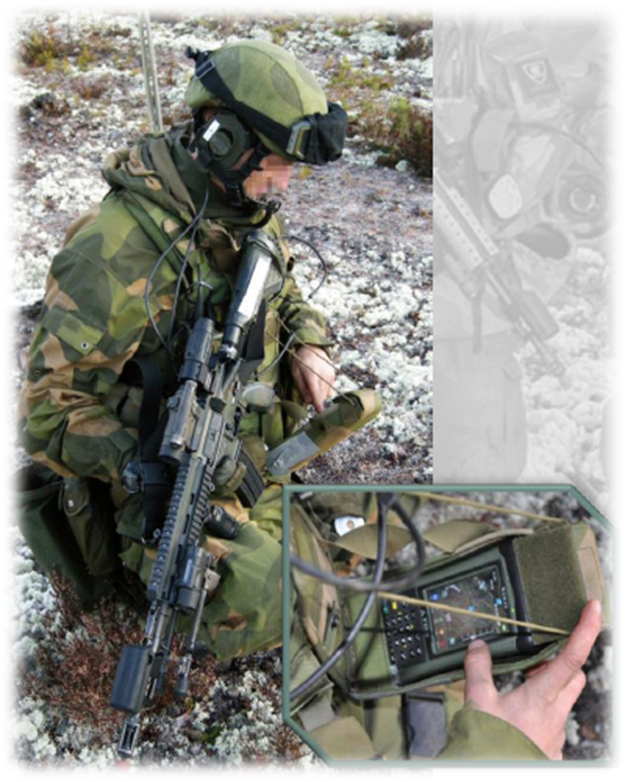
As announced in a recent press release, the Norwegian Defence has decided to purchase NORMANS digitised soldier system (Norwegian Modular Arctic Network Soldier) based on the concept that has been designed and tested at the Norwegian Defence Research Establishment (FFI). The Norwegian MoD has asked the Norwegian Defence Logistics Organisation to contract Thales Norway, with Teleplan Globe as partner, for delivering NORMANS.
The System
NORMANS gives soldiers superior situational awareness, with blue force tracking, navigation, target hand-off, and text messaging. The system enables soldiers to plan and complete operations with speed, precision and efficiency. The concept consists of: NORMANS Light, designed for the individual team members in a Dismounted Close Combat (DCC) squad, and NORMANS Advanced, tailored to the needs of the DCC squad leader and next in command. The improvement in combat effectiveness and safety are well documented.
NORMANS Light provides filtered situational awareness to all soldiers, keeping the weight and complexity of the system to a minimum, thus multiplying force efficiency and providing force protection.
NORMANS Light weights 150g (without cabling), and is powered directly from the radio, or from a central power unit.
NORMANS Advanced supports squad leaders’ command and control. It provides situational awareness and the secure distribution to subordinate units of orders, timecritical information and up-to-date operational pictures. NORMANS Advanced connects to a NATO C4IS through a national C4I System enabling blue force tracking, command and control and combat air support.
NORMANS Advanced weights 450g (without cabling and battery), and is powered directly from the internal battery. NORMANS Advanced supports a number of commonly used map and messaging formats, as well as IP-based communications.
The Context
The Norwegian Defence Research Establishment (FFI) has led a comprehensive program on forming the future Norwegian soldier solution in close collaboration with operational forces and Norwegian defence industry.
NORMANS has been through a 10 year process of iterative development, where Thales Norway has led the industrialisation of NORMANS digitised soldier system with Teleplan Globe as partner. FFI has documented significant improvement in operational effectiveness and increased safety for the soldier with NORMANS compared to the current solution which is based on paper maps and hand held GPS.
As the Prime contractor, Thales Norway will be responsible for delivering information systems to Norwegian soldiers over a 5 year period
Comments
“NORMANS digitised soldier system will provide Norwegian soldiers with improved situational awareness, improved ability to navigate and will provide effective mission planning. As a result of this soldiers will have increased effectiveness and safety in operations”, says Secretary of State in the MoD, Roger Ingebrigtsen.
“Soldier modernisation has been a focus area for Thales over the past 10 years. We have had strong collaboration with The Norwegian Defence, the Norwegian Defence Research Establishment and a number of Norwegian industrial players in the process of industrialising the future Norwegian soldier solution. We are proud to be chosen to deliver the NORMANS system, and we are looking forward to continuing the close collaboration with Teleplan Globe and other Norwegian industrial players in order to provide Norwegian soldiers with improved operational effectiveness and safety. NORMANS has already gotten attention internationally and we are also looking forward to offering the system outside of Norway”, says CEO of Thales Norway, Glenn Pedersen
Further Readings
News Report
As announced in a recent press release, the Norwegian Defence has decided to purchase NORMANS digitised soldier system (Norwegian Modular Arctic Network Soldier) based on the concept that has been designed and tested at the Norwegian Defence Research Establishment (FFI). The Norwegian MoD has asked the Norwegian Defence Logistics Organisation to contract Thales Norway, with Teleplan Globe as partner, for delivering NORMANS.
The System
NORMANS gives soldiers superior situational awareness, with blue force tracking, navigation, target hand-off, and text messaging. The system enables soldiers to plan and complete operations with speed, precision and efficiency. The concept consists of: NORMANS Light, designed for the individual team members in a Dismounted Close Combat (DCC) squad, and NORMANS Advanced, tailored to the needs of the DCC squad leader and next in command. The improvement in combat effectiveness and safety are well documented.
![]() |
| NORMANS Light (left) and NORMANS Advanced (right) |
NORMANS Light weights 150g (without cabling), and is powered directly from the radio, or from a central power unit.
NORMANS Advanced supports squad leaders’ command and control. It provides situational awareness and the secure distribution to subordinate units of orders, timecritical information and up-to-date operational pictures. NORMANS Advanced connects to a NATO C4IS through a national C4I System enabling blue force tracking, command and control and combat air support.
NORMANS Advanced weights 450g (without cabling and battery), and is powered directly from the internal battery. NORMANS Advanced supports a number of commonly used map and messaging formats, as well as IP-based communications.
The Context
The Norwegian Defence Research Establishment (FFI) has led a comprehensive program on forming the future Norwegian soldier solution in close collaboration with operational forces and Norwegian defence industry.
NORMANS has been through a 10 year process of iterative development, where Thales Norway has led the industrialisation of NORMANS digitised soldier system with Teleplan Globe as partner. FFI has documented significant improvement in operational effectiveness and increased safety for the soldier with NORMANS compared to the current solution which is based on paper maps and hand held GPS.
As the Prime contractor, Thales Norway will be responsible for delivering information systems to Norwegian soldiers over a 5 year period
Comments
“NORMANS digitised soldier system will provide Norwegian soldiers with improved situational awareness, improved ability to navigate and will provide effective mission planning. As a result of this soldiers will have increased effectiveness and safety in operations”, says Secretary of State in the MoD, Roger Ingebrigtsen.
“Soldier modernisation has been a focus area for Thales over the past 10 years. We have had strong collaboration with The Norwegian Defence, the Norwegian Defence Research Establishment and a number of Norwegian industrial players in the process of industrialising the future Norwegian soldier solution. We are proud to be chosen to deliver the NORMANS system, and we are looking forward to continuing the close collaboration with Teleplan Globe and other Norwegian industrial players in order to provide Norwegian soldiers with improved operational effectiveness and safety. NORMANS has already gotten attention internationally and we are also looking forward to offering the system outside of Norway”, says CEO of Thales Norway, Glenn Pedersen
Further Readings
Subscribe to:
Posts (Atom)