News Report
As announced in a recent press relase, Finmeccanica, through its controlled operating companies SELEX Elsag and SELEX Sistemi Integrati's VEGA, together with its partner Northrop Grumman, has been awarded a contract by the NATO Consultation, Command and Control (NATO C3) Agency to develop, implement and support the NATO Computer Incident Response Capability (NCIRC) - Full Operating Capability (FOC).
The contract, worth around EUR 50 million, is for an extensive managed service which will provide information assurance to around 50 NATO sites and headquarters throughout 28 countries worldwide. The NCIRC will provide the capability to detect and respond to cyber security threats and vulnerabilities rapidly and effectively. The project is intended to meet the level of ambition of NATO Head of States as set out during the Lisbon Summit in November 2010.
This award is result of a competitive selection process for which NATO collected bids from more than 300 companies across its 28 member nations. The list of the bidders included some of the world's top defense companies, such as Lockheed Martin, IBM and SAIC.
The Context
Today, the NCIRC - Initial Operating Capability (IOC) already provides NATO’s Cyber Defence capability to respond to computer security threats and vulnerabilities rapidly and effectively. It provides the means for handling and reporting incidents as well as disseminating important incident-related information to system and security management. It concentrates incident handling into one centralised and co-ordinated effort, thereby eliminating duplication of effort. However, it does not yet protect all the networks within NATO.
The upcoming NCIRC - Full Operating Capability (FOC) aims not only at a technology refresh of the existing NCIRC IOC capability but will also introduce new technologies to improve cyber defence situational awareness and enhance NATO’s ability to respond to evolving cyber-threats.This upgraded capability, which will be implemented by the end of 2012, will lay out a strong foundation for cyber defence information sharing in a federated environment.
Later increments of the NCIRC FOC project will provide NATO with the means to further develop cyber defence situational awareness by dynamically assessing and managing the level of risk in its CIS thus providing the Alliance greater flexibility in its conduct of network centric warfare.
Comments
“This outcome clearly demonstrates the ability of Finmeccanica to draw on leading capabilities across its group to provide leading-edge Cyber Solutions to such an important international organisation. We are delighted that this strong partnership, combining the capabilities, resources and expertise of both organisations spanning the UK, US and Italy has been selected to offer what we believe is the superior solution best meeting the requirements of this key NATO Programme which Finmeccanica is fully committed to delivering successfully” said Giuseppe Orsi, Chairman and CEO of Finmeccanica.
“We are pleased to be part of the team selected for this strategically important NATO programme,” said Mike Papay, Vice President Cyber Initiatives of Northrop Grumman Information Systems. “Northrop Grumman looks forward to bringing its talent, resources and decades-long expertise in building and operating national-level cyber security management centres, both in the U.S and U.K., to this programme to help protect NATO’s networks from advanced cyber threats.”
References: Finmeccanica (1), C4I Technology News (2)
Key events in the domain of Command, Control, Computer, Communications and Intelligence for Homeland Defense and Homeland Security applications. Technology reviews, product insights, contract awards, news reports, and press releases.
Showing posts with label Organization: NATO. Show all posts
March 2, 2012
January 31, 2012
Combined Endeavor 2012: let the planning begin
News Report
As reported by U.S. European Command's web-site, the week-long initial planning conference in Slovak Republic for the exercise Combined Endeavor 2012 (CE12) began yesterday with more than 250 participants attending to begin planning.
Combined Endeavor is the largest Command, Control, Communications and Computers (C4) interoperability event in the world: over than 1000 communications professionals from 40 NATO, Partnership for Peace (PfP), and strategic security partners gather at a main operating base, a virtual forward site, and at multiple home stations supporting live troop movements and training via HF and/or a satellite backlink to conduct a series of operationally focused interoperability tests. Combined Endeavor prepares nations to collaborate, plan, and execute complex C4 systems in crisis response and combat operations. The exercise builds partnerships for regional and global operations between nations using communication and network systems, using both NATO and commercial standards to increase interoperability between nations.
Combined Endeavor is a U.S. European Command (EUCOM)-sponsored multinational initiative. The exercise has grown to be one of the main vehicles to demonstrate and propagate new interoperability concepts between NATO and Partnership for Peace (PfP) nations. Its primary focus is interoperability testing of C4 systems and identification and documentation of problems hindering interoperability. The secondary focus is to develop long-range action plans that result in the achievement of increased levels of interoperability among NATO and the PfP nations.
In 2011, the Italian Army deployed the core network for Combined Endeavor, supporting more than 35 countries participating in the exercise, that was held in Grafenwoehr, Germany.
Comments
Lt. Col. Brian Heberlie, CE12’s exercise director, reiterated the importance of CE at the opening ceremony of the meeting in the Slovak Republic. “The planning is always the hardest part and, if we are successful here, we’ll have another challenging and successful exercise next fall. It’s important to remember as we start the work this week that Combined Endeavor is not only about conducting the technical planning and testing, but, just as importantly, the creation of new partnerships and friendships while strengthening those that already exist. It is the human interoperability piece that truly ensures the work will get done.”
References: U.S. European Command (1), GlobalSecurity.org (2), Combined Endeavor (3), dvids (4)
January 30, 2012
U.S. and French Navy conduct interoperability tests in preparation of next Bold Alligator Exercise 2012
News Report
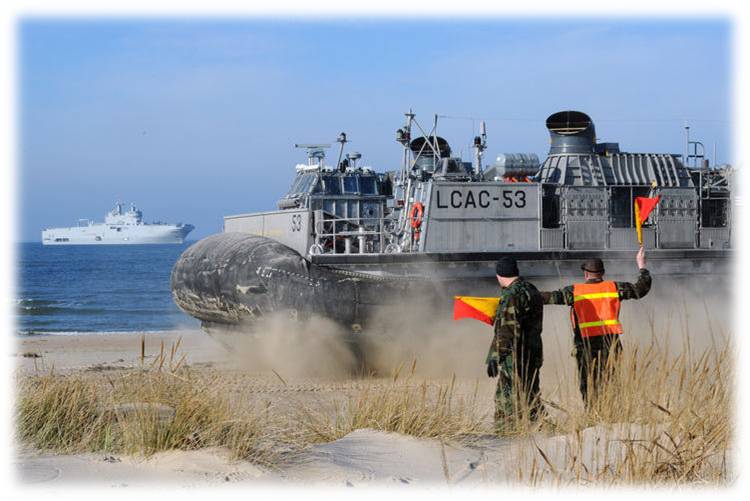
As illustrated in a recent news release, a naval interoperability exercise between the United States and France (which are NATO Allies) took place on January 25th and 26th on the beaches of Fort Story in Virginia Beach, U.S.A. The rehearsal exercise was conducted in preparations for the next multi-national amphibious exercise Bold Alligator Exercise 2012 that will take place in Camp Lejeune, North Carolina, U.S.A., involving the navies of the U.S., Australia, Canada, France, Italy, Netherlands, New Zealand, Spain and the United Kingdom.
During the exercise, Assault Craft Unit Four (ACU4) Sailors trained with the crew of French Projection and Command ship (BPC) FS Mistral (L9013).
![]() |
| U.S. Navy Landing Craft Air Cushion (LCAC) Vehicle from Assault Craft Unit Four (ACU-4) |
![]() |
| French Navy FS MISTRAL L9013 |
Exercise Bold Alligator 2012 (BA12) is expected revitalize U.S. Navy and Marine Corps amphibious expeditionary tactics, techniques and procedures, and reinvigorate its culture of conducting combined Navy and Marine Corps operations from the sea. BA12 will be a live and synthetic, scenario-driven, simulation-supported exercise designed to train Expeditionary Strike Group 2 (ESG 2), 2d Marine Expeditionary Brigade (2d MEB) and Carrier Strike Group 12. Staffs will plan and execute a MEB-sized amphibious assault from a seabase in a medium land-and-maritime threat environment to improve naval amphibious core competencies.
The exercise will run Jan. 30 through Feb. 12, ashore and afloat, in and off the coasts of Virginia, North Carolina and Florida
The Context
The numerous opportunities created by the U.S. and French armed forces through exchange programs, permanent sharing and exercises like Bold Alligator 2012 represent the very foundation of the many bilateral partnerships between NATO Nations. The Bold Alligator Exercise, although not a NATO exercise, is an example of how NATO Nations like the U.S. and France can work together to enhance interoperability and to strengthen the Trans-Atlantic link.
A bilateral exercise of this nature serves as a major contributor to Lessons Learned for all Allied nations. It is an opportunity to observe how exercises and operations are conducted while determining best practices and what works well between two national forces. All exercises between NATO nations, whether in a NATO context or not, are valuable to enhancing interoperability skills and capabilities.
Old con-ops will be studied and validated or dismissed in favor of new lessons learned. Ships planes and weapon systems currently in the fleet will be employed. New advances in command and control will be looked at and vetted.
Comments
"We have worked with the French navy not only here, but also in Toulon, France, to ensure our landing craft and the Mistral's well deck are compatible," said Capt. Mike Ott, ACU4 commanding officer. "This exercise today is the culmination of that planning and work we did overseas."
"This provides the opportunity to ensure that both the French and U.S. sailors understand differences in the crafts and can adapt correctly to them, so we can execute any mission safely," said Ott. "It is critical that we are able to conduct these operations, so that at any time and place in the world we could join forces with our French allies for any operation, such as Operation Odyssey Dawn in Libya, with little warning and little preparation and be 100 percent combat ready in a very short time."
References: NATO (1), U.S. Navy (2,3), SLD (4)
December 20, 2011
NATO activites and planned acquisition in the Cyberspace (second part)
News Report
Yesterday we focused our attention on the important developments that are occurring in the area of cyber defence within the NATO. By reporting the speech of NC3A's General Manager Mr Georges D’hollander (at the last AFCEA Cyber Security Defence Conference), we introduced the key activities that are under development within the Alliance for supporting member and partner Nations in the possible event of a significant cyber attack.
In this context, The NATO Computer Incident Response Capability (NCIRC) appears as the basic program that will increase NATO’s Cyber Defence capability to respond to computer security threats and vulnerabilities. NCIRC is expected to provide the means for handling and reporting incidents as well as disseminating important incident-related information to system and security management. It concentrates incident handling into one centralised and co-ordinated effort, thereby eliminating duplication of effort.
As reported by The Wall Street Journal and other news sources, NATO is starting to collect bids from more than 300 companies across its 28 member nations for the NCIRC. The list of the bidders includes some of the world's top defense companies, such as Lockheed Martin, Northrop Grumman, Finmeccanica, IBM and SAIC.
Finmeccaninca and Northrop Grumman, in particular, announced the signing of a cooperation agreement for bidding on the NCIRC. The agreement - which does not indicate timing or potential value - should meet the requirements for NCIRC Full Operational Capability (FOC). Finmeccanica will participate in the program through its Cyber Solutions unit, a new brand which is responsible in for all the activites of the Group dealing with the Cybersphere. "This is an intense collaboration that combines the power, resources and expertise of both companies in the United Kingdom, the United States and Italy, which led to an offer capable of satisfying the requirements of this major program of NATO," said Alberto de Benedictis, CEO of Finmeccanica UK.
The €32 million ($42 million) contract for NCIRC, although valued at less than the price of one fighter jet, holds great significance because it cements the alliance's role in protecting cutting-edge infrastructure, say NATO officials.
In the meantime, NATO conducted from 13 to 15 December a cyber defence exercise in order to test technical and operational Alliance cyber defence capabilities. The exercise, called Cyber Coalition 2011, was an opportunity to test Alliance working procedures for responding to large scale cyber attacks targeting information infra-structures of NATO and individual countries. The exercise was based on a fictitious crisis in which all participant nations had to deal with simulated cyber attacks. The scenario of the exercise required action, coordination and collaboration from cyber defence specialists and management bodies. A total of 23 NATO and six partner nations nations were involved in the exercise. Around 100 specialists took part in the exercise from locations in the Alliance’s SHAPE Headquarters in Mons and the NATO Headquarters in Brussels. A similar number of national experts participated from national cyber defence facilities in their respective countries.
References: C4I Technology News (1), The Wall Street Journal (2), GovconWire (3), DedaloNews (4), NATO (5)
December 19, 2011
NATO developments in the area of Cyber Defence
News Report
On last 7 December 2011, NC3A's General Manager Mr Georges D’hollander, spoke at the AFCEA Cyber Security Defence Conference presenting some important development in the area of cyber defence in NATO.
Here we report a few excerpts of his speech.
The Key Role of Intelligence
When we talk of cyber defence, we often jump straight away to new capabilities and technologies that the Alliance is developing. This is certainly important. But we should not forget about NATO’s traditional capabilities such as intelligence-sharing, defence planning or exercises. A cyber attack is in many ways similar to a ballistic missile attack. When the attack is launched, you only have minutes to respond. The warhead is not physical one, but it can be equally devastating. This is why you want as much intelligence as you can beforehand, to predict a potential threat. This is also why you want your response to be as well rehearsed as possible. One of my messages to the national representatives here is – do not treat cyber defence purely as a matter of technology.
NATO NCIRC
The NATO Computer Incident Response Capability (NCIRC) IOC (Initial Operating Capability) currently provides NATO’s Cyber Defence capability to respond to computer security threats and vulnerabilities rapidly and effectively. It provides the means for handling and reporting incidents as well as disseminating important incident-related information to system and security management. It concentrates incident handling into one centralised and co-ordinated effort, thereby eliminating duplication of effort. However, it does not yet protect all the networks within NATO. The upcoming NCIRC Full Operating Capability (FOC) project, for which my Agency is the procurement agent, aims not only at a technology refresh of the existing NCIRC IOC capability but will also introduce new technologies to improve cyber defence situational awareness and enhance NATO’s ability to respond to evolving cyber-threats.This upgraded capability, which will be implemented by the end of 2012, will lay out a strong foundation for cyber defence information sharing in a federated environment. Later increments of the NCIRC FOC project will provide NATO with the means to further develop cyber defence situational awareness by dynamically assessing and managing the level of risk in its CIS thus providing the Alliance greater flexibility in its conduct of network centric warfare. In any case, the term ‘Full operational Capability’ is quite a misnomer since, given the evolution of cyber threats, it is unlikely that any capability to counter them could ever be final or full. The project will, however, significantly boost NATO’s capability to face the evolving threat.
Coordination between NATO and National Cyber Authorities
To reap full benefit of the common interests in achieving cyber defence capabilities, a greater effort is required to align national activities in addition to coordination. This requires a dedicated structure to continually monitor national requirements and efforts and to coordinate and strategize on the way forward so as to ensure that there is no dispersion of efforts and that the tempo of research and development activities is in line with the assessment of the risks against NATO and national CIS. Establishing this structure and facilitating the coordinated development of cyber defence capabilities is the purpose of the MNCD programme (Multinational Cyber Defence Capability Development) initiated by NC3A.
Through an informal analysis of existing capabilities and needs, the following three areas have been identified as possible initial targets for MNCD: 1) cyber defence information sharing, 2) cyber situational awareness, and 3) a distributed multi-sensor collection and correlation capability.
The development of an initial cyber-defence information sharing capability, would enable efficient exchange of cyber defence information such as incident information, attack signatures, and threat assessments, between national Computer Emergency Response Teams (CERTs) including the NATO Computer Incident Response Capability (NCIRC).
Concerning cyber situational awareness, for most NATO Nations operational cyber defence is performed using a variety of tools and products including Intrusion Detection System (IDS) and other sensors, Security Incident and Event Managers (SIEM), vulnerability databases, and network monitoring software. These tools typically operate individually and there is no overall view. Cyber defence situational awareness is, therefore, achieved by experts manually consulting and consolidating a variety of feeds. Significant competency and a lot of manual effort are required. The joint development of this capability would simplify and enable quick decision making in the cyber domain, especially in a coalition environment, by providing a flexible set of visual interfaces (e.g. dashboards, dynamic views, and reporting features).
Distributed Multi-sensor Collection and Correlation Infrastructure capability would provide the means to coherently collect and correlate data from multiple sensors in an efficient and distributed manner so as to enable flexible management of sensor data storage and run a variety of correlation algorithms against the collected data.
Read the Full Speech
NATO provides virtualised information services in Afghanistan
News Report
As reported by Digital Battlespace and other news sources, the NATO Consultation, Command and Control Agency (NC3A) has successfully achieved a fully virtualised information services infrastructure for the International Security Assistance Force (ISAF) in Afghanistan.
In a statement released on 10 December, NC3A said the ‘significant three-year engineering and programmatic effort’ comprised ‘a major step forward, one that is still to be equalled in the NATO static command structure’. The organisation’s Capability Area Team has ‘evolved’ the ISAF server and storage infrastructure into a ‘modern, resilient and energy efficient capability’, the statement outlined.
The first virtualised solution was deployed to Afghanistan in 2009 under the Centrix-ISAF project, which installed the initial resilient Network Interconnection Points connecting the US Centrix-ISAF capability and NATO, thus creating the single information domain now known as the Afghanistan Mission Network. From there, with the creation of the ISAF Joint Command HQ (IJC) at the Kabul International Airport in 2010 the concept advanced, again with a redundant server room approach.
In March 2011, fully virtualised server rooms were installed at Kandahar Airfield. Since then all server rooms at the Regional Commands, HQ Kabul and IJC have been virtualised, and all Functional Area Services have migrated into this infrastructure, ahead of schedule. This move towards virtualisation is believed to have saved ISAF a total of some $1.2 million, broken down into $65,000 in non-recurring costs, and $234,000 per year in operating costs over a five-year life cycle, according to NC3A.
It allows commanders to quickly recover information from equipment failures without loss of data through this new method, and hardware deployment into theatre becomes less of an issue because NC3A provides it also.
Related Documents
- NATO supporting ISAF (video)
References: Digital Battlespace (1)
December 16, 2011
NATO Air Command and Control Information Services project passes the Critical Design Review
News Report
As reported on NC3A Newsroom, the NATO Air Command and Control Information Services project (AirC2IS) has successfully passed the Critical Design Review milestone and produced a solid design for the first of three AirC2IS implementation increments. This blue sky system implementation is unique for NATO: designed according to the NATO Network Enabled Capability (NNEC) tenets, it will operate, in the ever changing coalition environment, as the air functional service of the Bi-Strategic Command Automated Information System (Bi-SC AIS).
The System
The purpose of the AirC2IS system is to provide the NATO Air Operations Staff with an integrated, robust and flexible capability for the planning, analysis, monitoring and coordination of air operations. The AirC2IS capability will be used by Allied strategic and operational HQs established under the NATO Command Structure including: the Allied Command Operations, Joint Force Commands and Component Commands. It is also expected that the AirC2IS capability will be used by Combined Joint Task Force HQs, High Readiness Force HQs, Crises Response Operations forces, coalitions and other supporting activities, as authorised.
The system will also support distributed air planning and execution across all component commands. Allied Transformation Command (ACT) will use AirC2IS capabilities for transformation experimentation related to Air C2 and for training and exercise as well.
The AirC2IS is intended to operate as a fully integrated component of the NATO Bi-Strategic Command (Bi-SC) Automated Information System (AIS) and to serve as a baseline for future enhancement. The services provided by the AirC2IS are required to complement the Bi-SC AIS core services with an integrated and supported suite of Air C2 services, capable of supporting the work of Air staffs at all static and deployable Command Facilities of the NATO Command Structure.
AirC2IS will be NATO’s first Network Enabled Capability by design.It will be a system that is forward looking and will equip the operational users to face the changing NATO environment and security challenges. This modern implementation will set a benchmark for future NATO Bi-SC AIS Functional Services.The project will deliver a key component of the NATO active layered theatre ballistic missile defence (ALTBMD) Initial Operational Capability and provide a foundation which may be leveraged in the future for Missile Defence.
In accordance with the NATO AirC2IS Capability Package, the project is implemented based on a Spiral Development approach that will be executed in three increments to complete the AirC2IS capability. Each increment should provide an integral, usable, and operationally-fielded capability. The AirC2IS Increment 1 (AirC2IS-1) capability is also envisioned to expose those services and products needed by other Bi-SC AIS functional areas, such as the Air Operations Directive (AOD), Air Space Control Order (ACO), Recognized Air Picture, and reporting of air order of battle information.
The initial AirC2IS baseline is scheduled to be piloted at two operational sites in the fourth quarter of 2012, andd an initial operational capability, installed at all sites, is expected by second quarter 2013.
The signature ceremony for the Air C2IS contract was held on last January 2001, between NC3A and Siemens IT Solutions and Services Turkey.
Reference: NC3A (1,2)
December 2, 2011
Contract Award: ThalesRaytheonSystems to upgrade NATO Active Layered Theatre Ballistic Missile Defence
News Report
As announced in a recent press release, ThalesRaytheonSystems has been awarded a contract by the NATO Air Command and Control System (ACCS) Management Agency on behalf of the NATO Active Layered Theatre Ballistic Missile Defence programme (ALTBMD), to upgrade the operational hardware and software of the ALTBMD Territorial Missile Defence (TMD) Interim Capability (InCa).
The System
ALTBMD is a System of Systems providing the NATO with the capability to defend NATO Forces, deployed either within or beyond NATO's Area of Responsibility, against the threat posed by Tactical Ballistic Missiles with ranges up to 3000 km.
ALTBMD does not create another separate NATO system, but adapts existing systems to support NATO Territorial Missile Defence (TMD). Systems being integrated into the ALTBMD are:
- the NC3A BI-SC AIS (NATO Consultation, Command and Control Agency Bi-Strategic Commands Automated Information System)
- the NACMA ACCS (NATO ACCS Management Agency Air Command and Control System)
- the NGCS (NATO General Communication System)
- sensors and weapon systems provided by the NATO Nations, and integrated into the NATO ICC (Integrated Command and Control System).
- Step 1 provides some of the required functionality by leveraging NATO research programmes in the Theater Ballistic Missile Defence area. The Step 1 InCa is based on NC3A Bi-SC AIS Prototype 1, that is interfaced with the NATO ICC system and deployed in the locations designated by the NATO Military Authorities. The implementation of TMD Interim Capability Step 1 has provided an early operational capability to the user community and at the same time provides a building block for a more robust Interim Capability.
- Step 2 provides the full interim functionality required by the NATO Strategic Commands. Building on Step 1, additional Theater Ballistic Missile Defence area planning and tasking functionality as well as interfaces with national systems will be fielded, and Situational Awareness functionality will be included. The final step of the Interim Capability will provide enhanced coordination between the various NATO levels of command, resting atop the NGCS that provides the underlying communication services for the NATO ALTBMD Interim Capability.
The Context
Recognizing the need for missile defence to counter nuclear, biological and chemical (NBC) threats, the 1999 NATO strategic concept stated: “The Alliance's defence posture against the risks and potential threats of the proliferation of NBC weapons and their means of delivery must continue to be improved, including through work on missile defence. The aim in doing so will be to further reduce operational vulnerabilities of NATO military forces while maintaining their flexibility and effectiveness despite the presence, threat or use of NBC weapons.”
In May 2001, NATO launched two feasibility studies conducted by teams led by Lockheed-Martin and SAIC. The Active Layered Theatre Ballistic Missile Defence programme (ALTBMD) was established in September 2005 after the completion of the two-year feasibility study in which eight NATO nations and various NATO projects cooperatively participated. The focus of the programme was the upgrade, test and integration of NATO’s command and control (C2) systems and underlying communication network to enable effective information exchanges between various NATO and national missile defence systems in both real-time (engagement) and non real-time (planning). This integrated system-of-systems architecture will create a larger range of detection, communication and missile defence capabilities for NATO forces, whether deployed within or beyond NATO’s area of responsibility. It will also provide complete coverage against the threat posed by tactical ballistic missiles with ranges up to 3,000 kilometres.
In November 2006, at the Riga Summit Meeting of NATO Heads of State and Government, an SAIC corporate officer and the ALTBMD Programme Manager signed the official agreement (the NATO Secretary General looks on). This $95 million contract envisioned the fielding of both an initial operational capability (IOC) and a final operational capability (FOC).
In 2007, ALTBMD members, voluntary national contributors and national experts from nine contributing NATO nations combined with company members to form Integrated Project Teams in The Hague. These IPTs included companies from several member nations, including: Finmeccanica, Diehl, EADS, iABG, QinetiQ, Raytheon, Thales and ThalesRaytheonSystems.
An important milestone for the programme is achieved in 2008 when the ALTBMD integration and test facility (known as the “Integration Test Bed - ITB”) becomes operational (ahead of schedule). Consisting of computer simulation tools to test the architectures, it started to be used for integration tests to ensure that all national systems worked effectively together. With connections to participating member nations' operations and test facilities throughout the Alliance, the approach to the development of this complex system of systems was based on extensive prototyping, design and implementation of advanced architectures, and their validation through modelling and computer-based simulation.
The programme kept on incrementally building toward its final Reference Architecture in two distinct phases, known as Capability 1 and Capability 2. Capability 1 includes the available C2 units, sensors and lower tier weapon systems, while Capability 2 will add upper tier weapon systems.
In 2009, an early capability requested by the NATO Strategic Commands began to be fielded (Interim Capability - InCA), providing some of the required functionality by leveraging NATO research programmes in the TBMD area and capabilities that were currently in use. The fielding of InCA 1 was completed on 2010 to 18 NATO sites.
Pursuant to the expanded NATO ambition for missile defence as articulated at the Lisbon Summit, a contract was also signed on 20 September 2011 with an industry consortium led by SAIC. This team joined the Programme Office at the NATO C3 Agency in The Hague on 3 October 2011 to develop the detailed technical requirements to transform NATO’s Theatre Missile Defence Programme into a programme to protect the NATO territory and populations. The consortium includes: France (EADS Astrium), Germany (IABG), Italy (Finmeccanica's SELEX Sistemi Integrati), The Netherlands (TNO), the UK (QinetiQ) and the U.S. (SAIC, Raytheon).
Under the last awarded contraco, ThalesRaytheonSystems will be upgrading TMD InCa Step 2 to the latest configuration of NATO Air Command and Control System (ACCS). As the world’s first fully integrated C2 system for planning, tasking and execution of air operations, NATO ACCS replaces multiple aging air C2 systems in the NATO nations.
Comments
“ThalesRaytheonSystems is committed to supporting this alliance focused approach. Systems such as the Air Command and Control System Level of Operational Capability 1 (ACCS LOC1) and Missile Defence on top of ACCS LOC1 will be critically important to fight as one alliance with warfighters from across the nations trained on common highly interoperable Command and Control systems,” said Jack Harrington, CEO, ThalesRaytheonSystems, during a briefing to NATO and industry participants at the contract signature ceremony in the NATO headquarters in Brussels, Belgium.
November 30, 2011
Project Review: the Afghan Mission Network
All ISAF forces (~100,000 additional users) must move to a common network to more effectively share information and resources across AfghanistanHistory
(General Stanley McChrystal, USA, COMISAF)
ISAF (International Security Assistance Force) was created in accordance with the Bonn Conference in December 2001. Afghan opposition leaders attending the conference began the process of reconstructing their country by setting up a new government structure, namely the Afghan Transitional Authority. The concept of a UN-mandated international force to assist the newly established Afghan Transitional Authority was also launched at this occasion to create a secure environment in and around Kabul and support the reconstruction of Afghanistan.
On 11 August 2003 NATO assumed leadership of the ISAF operation, ending the six-month national rotations. The Alliance became responsible for the command, coordination and planning of the force, including the provision of a force commander and headquarters on the ground in Afghanistan.
For the majority of organizations operating in Afghanistan, the problem was not data scarcity. This was particularly evident after the first years of operations and interaction with military units, local and national leaders, regional and global media, fact-finding teams, governmental and non-governmental survey organizations, and an alphabet soup of other international actors. Rather than scarcity of data, it was both data overload and the “glare” of ambiguous, contradictory, inconsistent, latent, and incomplete reporting that often caused ISAF forces to avert their eyes and diffuse their attention from the underlying dynamics and relationships of key actors and drivers that really matter in the Afghan operating environment.
Already in 2006 the U.S. and NATO embarked on an effort to establish mail exchange between the NATO and U.S. mission networks. The U.S. mission network at the time was the Combined Enterprise Regional Information Exchange System (called CENTRIXS) Global Counter Task Force (GCTF) and NATO operations were conducted on ISAF SECRET. This project sought to enable email exchange between the two networks. Although the objective was achieved (mail was exchanged), the solution included various guards, firewalls and intrusion detection systems that made it difficult to use and administer. It was so difficult that the system failed for 35 days without even being reported.
The next notable effort in NATO-national interoperability in Afghanistan was the UK-led effort, OVERTASK. With the UK forces deployed to Regional Command South and Helmand in 2005, there was a requirement for UK forces to be interoperable with coalition partners. The solution to meet this requirement was OVERTASK which was based on an enclave within the NATO mission network, ISAF SECRET. A portion of the ISAF SECRET was dedicated for the use of UK forces. As the UK operated on the same network as NATO forces, interoperability was assured. However, operating on the same network requires centralised configuration control. This centralised control maked it difficult for individual nations to install and operate their own nationally-developed systems without considerable coordination.
The real genesis of the Afghan Mission Network can be traced back to 2008, when the Afghanistan campaign plan was revised and the U.S. brass began to look for a way to develop a true mission network for Afghanistan. At that point the U.S. was mainly operating on SIPRnet and NIPRnet, while NATO and the coalition members were on the ISAF secret network. NATO funded an effort to provide voice, chat and Web access over a United Kingdom network called Overtask. But there was still not a real capability for the U.S. to communicate with coalition members at the secret level.
In order to increase situational awareness, Gen. Stanley McChrystal, commander of the ISAF and U.S. Forces Afghanistan, required each coalition nation to share information on a single information infrastructure, the Afghanistan Mission Network. On 7 April 2010, NATO’s resource committees formally approved the way ahead for the Afghan Mission Network project, which radically changed the way Nations contributing to the ISAF mission share information.
The Afghan Mission Network basically provided the connective tissue between the U.S. CENTRIXS (Combined Enterprise Regional Information Exchange System), which is the theater version of SIPRNet, and NATO’s ISAF Secret network, to which the networks of the other ISAF nations connect. By law, SIPRnet does not allow access to non-U.S. users.
Initial operating capability for the network was declared in July 2010, signifying the availability of the network to at least 50 percent of all ISAF forces. AMN’s initial capabilities facilitated human-to-human contact that includes chat, VoIP telephone connectivity, e-mail, Web browsing, friendly force tracking exchange and video teleconferencing.
Analysis
Tipycally, Coalition forces do not easily share information, and Commanders had to gather at a central location to discuss plans without the use of advanced technology. Often, one of their only viable alternatives is to share mission-related information via "Sneaker net". This cumbersome practice called for the warfighter to transfer information onto removable media and manually move it from one system to another, which often is not secure, is very labor intensive, and prohibits information from being shared in a timely manner.
The Afghan Mission Network marks a strategic shift in the sharing of data.
U.S. Defense leaders and their counterparts from other nations say a network infrastructure linking coalition partners in Afghanistan has fundamentally changed the way the multinational effort has been conducted over the last several years. NATO, the U.S. military and other national forces say the Afghan Mission Network (AMN) as it now exists has been a game changer for operations in Afghanistan. Earlier efforts didn't work so well. As already stated, one progenitor to the AMN, geared toward bridging simple email capabilities between U.S. and NATO, was so cumbersome and hard to use that it went out of service for more than a month and no one noticed.
From their respective secure networks, and at their individual discretion, separate Coalition forces can share data, situational awareness and Commander’s intent across the battlefield on a centralized network.
AMN is also an example of technology that allows expeditionary forces to move their data as they deploy. Divisions install the AMN in their headquarters, which allow them to virtually move data when they deploy. This keep the units from having to physically move their servers and there is in principle no lag in the data because it is constantly being updated.
Nowaday, the success of the AMN is spreading beyond the ISAF coalition. Civilian partners in Non-Governmental Organisations (NGOs) have expressed interest in being able to share information with the AMN.
AMN in brief
The Afghanistan Mission Network AMN is the primary Coalition C4ISR network in Afghanistan for all ISAF forces and operations consisting of the ISAF-Secret network as the core with national extensions.
The Afghan National Army furnishes the infrastructure to enable the U.S. and other Coalition forces to provide them with relevant, though selective, data and situational awareness, which does not compromise the security of any partner including the U.S. The Afghan National Army can then respond, making crucial decisions based on current and comprehensive data.
As already stated, the ISAF Secret Network provided by the NATO NC3A is the heart of the AMN. It is connected via six network interconnection points to CENTRIXS and to the networks contributed by Italy, the United Kingdom and Canada. “If Italy wants to talk to us, they can transition across the ISAF core from their network and talk to us over CENTRIXS,” said Lieutenant Colonel Andy McClelland, who is attached to NATO Allied Command Transformation headquarters in Norfolk. “The core is the glue the binds all of the networks together.”
The AMN allows nations to operate their own network within the ISAF SECRET classification, which seamlessly connects to the ISAF SECRET core through a series of Network Interconnect Points (NIPs).
AMN enables the 45 nations of the Coalition to unite and fight the enemy as a single force, leveraging the combined strength of each partner.
Red, Blue, Green, White
Different national networks use different viewers to examine data, i.e. the Canadians use a system called BattleView, the U.S. uses Command Post of the Future and the British have a system called JADOCS. The firts task of AMN was to make data available to all these viewers. “Data is published on a server,” said U.S. Army Colonel Pete Gallagher, chief of the ISAF CJ6 branch, at ISAF headquarters in Kabul, Afghanistan, “and users subscribe to that data.”
But while the common perception is that battlefield systems provide information about friendly and enemy forces - so called blue and red forces - in Afghanistan, it may be the green and white icons on the screen that make the real difference. Green is the color for the Afghanistan government and security forces, while white represents the local population centers. “We’re trying to separate the red and the white, the insurgents from the population, and insert the green between them, which is the Afghan government and the security forces,” said Col. Derek Orndorff, USA, the communications director for the ISAF Joint Command in Kabul, Afghanistan. “That information is not in the normal, everyday battle command systems that we just pull off the shelf. This is all stuff that is created from the bottom up, from the guys who are on patrol walking around in the bazaars, who had a key leader engagement with an elder in a village. That information has to get into the system in ways that we’ve never done it before. We’ve been getting after that here in Afghanistan.”
One way of providing access to that information has been to add a wiki capability to the AMN that allows tip-of-the-spear forces to share vital human intelligence at all levels. By clicking on a particular city or region, for example, a commander can research local leaders, based on impressions and information provided by personnel who have had first-hand encounters.
Cyber Issues
The Conficker computer virus, which was first detected in 2008, reared its ugly head on April 2011 in Afghanistan, where it was detected on the Afghan Mission Network.
“We had an older virus that showed up on the network, and when that older virus was discovered, we immediately isolated it, protected the rest of the network, identified what we needed to do, and in about five hours, everybody was operating normally again,” says Col. Derek Orndorff. “It was the Conficker worm. It was a success story from our perspective because our tools picked it up, we identified it, we protected the entire network, and we were able to defeat the challenge relatively quickly and get back to business instead of letting it become debilitating to us.”
Col. Orndorff credited network transparency for helping to quickly stamp out Conficker. “AFN is a very open and flat network, so if a user on an ISAF machine wants to see something on the United Kingdom OVERTASK, there’s no login, no firewalls, no certificates, no passwords. There’s nothing. What that means is that everyone who is part of the network has a shared vulnerability. Everybody shares the same risks. So therefore, when we have challenges, we have to have transparency between all the different parts and pieces or you’re going have problems with it,” he explained. Without that transparency, CENTRIXS network operators could have chosen to remain mum about the Conficker vulnerability, which would have allowed it to spread. “This incident was a perfect example of why this is so successful, because everybody understands where their piece is in this so we can all work together.”
Comments
“On the battlefields of Afghanistan, AMN has transformed the way Coalition Commanders share information,” said Brig. Gen. N. Lee S. Price, PEO for C3T. “Independent discussions and planning efforts between separate Commanders of different nations have been replaced by data sharing across AMN.”
References: DefenseSystems.com (1,2,6,10), NATO (3,4), CimicWeb (5), AFCEA (7,11), Military Information Technology (8), KZO Innovations (9)
October 7, 2011
NATO Bold Quest Exercise 2011
References: NATO (1), National Guard (2), Rumor Mill News (3), Army Times (4), dvids (5)
News Report
Some interesting comments on NATO Bold Quest 2011 Exercise were published recently on NATO ACT news archive and other news sources. The exercise was hosted at Currently, Atterbury-Muscatatuck Complex, in Central Indiana, between Sept. 8th and Sept. 23rd. Here, 12 NATO member nations were involved in a joint staff combat assessment exercise designed to test the interoperability of target identification systems to reduce friendly fire incidents.
The exercise was aimed to test technologies driven by the need to provide tools to make warfighters more effective in engaging targets while minimizing the risk of fratricide by both ground and air forces. Participant nations include Australia, Belgium, Denmark, Finland, France, Germany, Italy, the Netherlands, Norway, Spain, Poland, the United Kingdom, the United States and NATO.
On the airfield at Camp Atterbury sat three giant cargo planes. Not American C-130s, but one plane from Italy and two from Germany. Inside the planes, NATO combat identification training was performed. Pilots tested those computer systems designed to identify friendly forces on the ground. They wanted to ensure that a German jet fighter can digitally identify coalition forces from all NATO countries.
The examined target identification systems included devices that soldiers wear in combat and devices mounted on their weapons. If a weapon is aimed at a target with the identification device, an indicator alerts the soldier taking aim that the target is "friendly" so the soldier can stop. Military NATO aircrafts are to be equipped with the same devices so as not to accidentally drop weapons on the wrong targets.
Other units already were engaged in interoperability training. Four Danish soldiers, four from Finland and two from Belgium called in airstrikes to an American pilot after an improvised explosive device attack.
Comments
"Bold Quest is a recurring series of operational demonstrations in which we bring coalition war fighters, technicians and analysts together in problem-solving partnerships that ultimately result in a major operational demonstration in the field. It's testing under operational conditions to the maximum extent that we can replicate," said John Miller, Bold Quest operational manager. "This year we have expanded the work in the human dimension of coalition combat identification".
"Our goal is to destroy the enemy and avoid fratricide,” said John Miller, “In coalition fighting, there can be a lot of confusion. The fog of war gets foggier.”
"I am grateful for the experience," said French Air Force Sgt. Jerome Fromentin. "Work in this kind of exercise makes our system more efficient. It's good to test our system with NATO -- it increases our compatibility," Fromentin said.
"Sharing of all information with other nations is the goal, to communicate," said French Air Force Maj. Laurent Pourtalet. "It's important to see how our system, Link 16, works with the Mirage 2000 (fighter aircraft), and can adapt to the German system. Communication is everything."
News Report
Some interesting comments on NATO Bold Quest 2011 Exercise were published recently on NATO ACT news archive and other news sources. The exercise was hosted at Currently, Atterbury-Muscatatuck Complex, in Central Indiana, between Sept. 8th and Sept. 23rd. Here, 12 NATO member nations were involved in a joint staff combat assessment exercise designed to test the interoperability of target identification systems to reduce friendly fire incidents.
The exercise was aimed to test technologies driven by the need to provide tools to make warfighters more effective in engaging targets while minimizing the risk of fratricide by both ground and air forces. Participant nations include Australia, Belgium, Denmark, Finland, France, Germany, Italy, the Netherlands, Norway, Spain, Poland, the United Kingdom, the United States and NATO.
On the airfield at Camp Atterbury sat three giant cargo planes. Not American C-130s, but one plane from Italy and two from Germany. Inside the planes, NATO combat identification training was performed. Pilots tested those computer systems designed to identify friendly forces on the ground. They wanted to ensure that a German jet fighter can digitally identify coalition forces from all NATO countries.
The examined target identification systems included devices that soldiers wear in combat and devices mounted on their weapons. If a weapon is aimed at a target with the identification device, an indicator alerts the soldier taking aim that the target is "friendly" so the soldier can stop. Military NATO aircrafts are to be equipped with the same devices so as not to accidentally drop weapons on the wrong targets.
Other units already were engaged in interoperability training. Four Danish soldiers, four from Finland and two from Belgium called in airstrikes to an American pilot after an improvised explosive device attack.
Comments
"Bold Quest is a recurring series of operational demonstrations in which we bring coalition war fighters, technicians and analysts together in problem-solving partnerships that ultimately result in a major operational demonstration in the field. It's testing under operational conditions to the maximum extent that we can replicate," said John Miller, Bold Quest operational manager. "This year we have expanded the work in the human dimension of coalition combat identification".
"Our goal is to destroy the enemy and avoid fratricide,” said John Miller, “In coalition fighting, there can be a lot of confusion. The fog of war gets foggier.”
"I am grateful for the experience," said French Air Force Sgt. Jerome Fromentin. "Work in this kind of exercise makes our system more efficient. It's good to test our system with NATO -- it increases our compatibility," Fromentin said.
"Sharing of all information with other nations is the goal, to communicate," said French Air Force Maj. Laurent Pourtalet. "It's important to see how our system, Link 16, works with the Mirage 2000 (fighter aircraft), and can adapt to the German system. Communication is everything."
September 27, 2011
NATO approves Air Command and Control System Factory System Tests
References: ThalesRaytheonSystems (1), NATO (2), NACMA (3)
News Report
As appeared on a recent press release, ThalesRaytheonSystems has received approval from the NATO Air Command and Control System Management Agency (NACMA) for successfully completing the NATO Air Command and Control System (ACCS) Factory System Test.
The System
The NATO Air Command And Control System (ACCS) is intended to combine, and automate, at the tactical level the planning and tasking and execution of all air operations. When operational, the ACCS will provide a unified air command and control system, enabling NATO’s European nations (including new Alliance members) to seamlessly manage all types of air operations over their territory, and beyond.
The system will provide for the management of the functions of air traffic control, surveillance, air mission control, air space management, force management, and command and control resource management.
At the planning and tasking level the system will be fielded in Combined Air Operations Centres (CAOCs). At the execution level, ACCS will be fielded in control centres that will provide facilities for aircraft control and production and dissemination of the Joint Environment Picture.
The Context
The ACCS was conceived in the 1980’s to replace existing air defence systems such as NADGE and GEADGE, but it wasn’t until 1992 that the North Atlantic Council agreed to the initial implementation of ACCS to a first level of operational capability in both static and deployable configurations.
The initial NATO contract, worth at the time some US $500M, was signed in 1999 with Air Command Systems International (ACSI), a French-registered company (now based in Massy near Paris) formed by two shareholders, Raytheon of the USA and Thomson-CSF (now THALES) of France. The contract provides for the development and testing of the ACCS system core software and hardware, and initial installation will occur in validation sites in Belgium, France, Germany and Italy which have each signed separate contracts with ACSI. Following successful testing and validation, replication of the software will occur in sites throughout NATO Europe.
NATO’s contract with ACSI is managed by the NATO ACCS Management Agency (NACMA) in Brussels. NACMA is the procurement and implementing body of the NATO ACCS Management Organisation (NACMO). Within its primary function as a system acquisition agency, NACMA’s tasks include; the central planning, system engineering, implementation and configuration management for the ACCS programme, and ensuring ACCS system integrity, integration and interoperability.
ACCS was identified as one of the “top 10” NATO priorities at the Lisbon Summit in 2010. With ACCS, NATO operators will have a state-of-the-art air C2 system responsible for 8 million square kilometers of European airspace and out-of-area NATO operations. ACCS will provide opportunities for common training, standard operational procedures and centralized maintenance for all NATO nations, significantly reducing support costs and increasing manning flexibility. As NATO evolves in the future, ACCS is designed to adapt to new operational challenges whether it be for continued advancements to air C2 or the addition of Ballistic Missile Defense capabilities, ACCS provides the solid command and control foundation for the alliance.
Comments
“NATO ACCS is the largest system of its kind to be delivered across multiple nations and provides critical new capabilities including resource management, Surface-to-Air Missile planning and automated flight safety aids in support of modern NATO operations”, said Jack Harrington, CEO, ThalesRaytheonSystems. “ACCS has left the factory to complete its validation at the NATO Test and Validation Facility, and the national operational sites.”
“The Factory System Test was a comprehensive set of technical and operational tests, giving NATO the confidence to move forward to the next validation phase and for ACCS to be the foundation for Ballistic Missile Defence C2 capabilities,” said Dr van der Giet, General Manager, NACMA. “The teamwork between NACMA and Industry was excellent, in particular through the performance of the specific NATO-designed end-to-end operational scenario.”
Subscribe to:
Posts (Atom)