Key events in the domain of Command, Control, Computer, Communications and Intelligence for Homeland Defense and Homeland Security applications. Technology reviews, product insights, contract awards, news reports, and press releases.
December 15, 2011
Evolving Satellite Ground Systems into Smartphone Applications
News Report
As reported in a recent press release, Lockheed Martin has signed a three-year Cooperative Research and Development Agreement (CRADA) with the U.S. Air Force’s Space Development and Test Directorate and Air Force Research Laboratory to improve the operation and affordability of satellite command and control.
Lockheed Martin will leverage its best engineering technologies from across U.S. DoD, Intelligence, and Civil programs to meet the challenges of operationally responsive ground system configuration to achieve “lights out” operations. Additionally, Lockheed Martin is scaling its ground station from a Space Operations Center down to a single laptop, and instantiating a ground system remotely from its host hardware (micro-cloud computing architecture), all while supporting multiple concurrent classified missions.
The project will culminate with live demonstrations in the Multi-Mission Satellite Operations Center (MMSOC) at Kirtland Air Force Base, N.M., late this year, 2012, and 2013. As the leader in USAF ground systems R&D, the Space Development and Test Directorate will provide access to space missions and the MMSOC for live experimentation. The Directorate will help guide the investigations, provide system configuration and flight operations support to experiments, and assess the potential technologies on behalf of the DoD.
Comments
“This agreement is a first step in opening up our architecture to the best ground station technologies in the private and civil sectors.” said Colonel John Anttonen, Chief of the Space Test and Operations Division at Kirtland AFB. “We are bringing the smartphone concept to our next generation ground systems where satellites are flown as apps and new technology can be rapidly inserted.”
“Under the agreement, the parties are working to research, develop, demonstrate, and evaluate successful technologies to more quickly and affordably configure and autonomously operate satellite command and control systems,” said Bob Kramer, Lockheed Martin IS&GS-Defense vice president for Operational Systems and Services. “We look forward to working with the Air Force on this important operationally-responsive C2 project.”
References: Lockheed Martin (1)
December 14, 2011
C4I Quarterly Trends, Reader's Choice and Editor's Pick
Within this entry, you'll find which news and reports got the highest level of attention during the last three months, organized in three separate charts.
The analysis of the posts published in this blog over the past three months has highlighted the following topics as real "trends" in the domain of C4I:
- The U.S. Network Integration Evaluation (NIE). The NIEs are a series of field exercises designed to integrate and mature the Army’s tactical network, as well as to evaluate deliberate and rapid acquisition solutions. Soldier feedback and test results from the NIEs are directly shaping the makeup of the U.S. Army's network Capability Set 13, which will begin fielding in fiscal year 2013 to up to eight brigade combat teams. Several reports on the last NIE (NIE 12.1) appeared on this blog in the last months, discussing the results of the experimentations in different technological areas: Network Integration Evaluation 12.1, U.S. Army concludes the NIE 12.1, The U.S. Army's assessment of Company Level network-centric capabilities, Network Management in Modern U.S. Army's Military Operations.
- Advances in manned to unmanned systems integration. An increasing family of programs and activities are dedicated on improving the level of integration of Unmanned Aerial Systems within military C4I architectures, as witnessed by the high number of entries that appeared in this blog in the last three months, such as: U.S. Navy demonstrates UAV to Weapons interoperability through a Service Oriented Architecture, Manned to Unmanned, Contract Award: Northrop Grumman to add Tactical Data Link technology on U.S. Army's "Hunter", Harris introduces multi-UAS controlling capabilities on Falcon III Radios, Controlling the drones during the battle.
- Cyber Defence goes on the Offensive. It is now clear that the new step in implementing an effective Cyber Defence capability requires the development of proper tools, procedures and legal frameworks for allowing offensive moves in cyberspace. This topic has been discussed in a number of posts, including: Finland's Cyber Strategy goes on the Offensive, U.S. Army's updated Information Operations Primer focuses on Cyber, U.S. Army's Cyber Brigade.
- Superior Quality Location Intelligence. Knowledge of the terrain over which military operations will be conducted is an essential prerequisite for their success, and as a matter of fact Armed Forces and Government Agencies are acquiring the best technologies to gather, process and distribute geographical information. Here are some of the most interesting posts on this topic: Contract Award: Thales and EADS to enhance the French Armed Forces' geographic database system, Contract Award: GeoEye to provide Web Hosting Services for US National Gospatial Intelligence Agency, SAIC unveils GeoRover Mobile software solution, RemoteView: Textron's imagery and geospatial analysis software.
- Enterprise Services Everywhere. Network Centric Warfare is no longer the the buzzword that anyone talks about, but it is still a fact that Service Oriented Architectures are effectively providing a superior level of integration among separate systems and centres. Here there are some examples: Contract Award: Lockheed Martin to improve intelligence sharing capability of US DoD, Contract Award: Alion S&T to support US Army's LandWarNet, Contract Award: TWD to provide enterprise IT services and support for US Naval Sea Systems Command, Planned Acquisition: US Navy issues draft RFP for its Next Generation Enterprise Network, Contract Award: US AOC Air and Space Operations Center Weapon System goes SOA, NGEN Update: less than five potential bidders will compete on price.
The following chart presents the entries that catched the highest level of attention by the readers of this blog.
- Contract Award: Thales and EADS to enhance the French Armed Forces' geographic database system. On last November, the French geographic Institute IGN (Institut Géographique National), acting as the contracting authority on behalf of the Direction Générale de l'Armement (DGA) of the French Ministry of Defence, has contracted Thales and Cassidian to carry out the second phase of the TopoBase Défense Operation. The goal of this operation is to produce data to feed into defence geographical databases.
- Contract Award: US AOC Air and Space Operations Center Weapon System goes SOA. On last October, Northrop Grumman has been awarded a contract for the design, development, test, and deployment of Increment 10.2, modernization of the Air and Space Operations Center Weapon System. Increment 10.2 is intended to bring net-centric capabilities to the Geographic Air and Space Operations Center Weapons Systems, thereby allowing data to flow seamlessly across various platforms and process workflows rather than being locked in separate information technology system “silos” to be accessed and retransmitted by humans, as is the process today.
- Project Review: the Afghan Mission Network. On the battlefields of Afghanistan, the Afghan Mission Network has transformed the way Coalition Commanders share information. Independent discussions and planning efforts between separate Commanders of different nations have been replaced by data sharing across the network.
- The UK Cyber Security Strategy. After a couple of postponements, on last November the UK Government has finally published its Cyber Security Strategy, which details UK plans to secure critical infrastructure and improve the country’s cyber-defenses to protect national security and citizens from multiple cyber-threats. The UK government classified cyber-security as a "tier one" national security priority in 2010 and set aside 650 million pounds over the next four years to be used for cyber-defense.
- Exercise SUDARSHAN SHAKTI: Indian Army's biggest war game to date. On last November sixty thousand troops and 300 tanks of the Indian Armed Forces (IAF) participated in the exercise codenamed 'Sudarshan Shakti', aimed at strengthening war fighting skills of army's Southern Command and IAF's South Western Air Command by bringing together all elements including air power on one single platform. In this overall effort, Network Centric Warfare (NCW) was one of the crucial aspects being validated.
And finally, here there is the list of the five most interesting posts as selected by the editor of this blog.
- Discussing the JTRS GMR "graceful termination". Large cost overruns and numerous schedule delays forced the US Army's hand in canceling the JTRS Ground Mobile Radio system. The US Army now plans to conduct a full and open competition early next year for a lower-cost alternative, said Major Christopher Kasker, a US Army spokesman. US Army spokesmans also reiterated that the backbone of the Army's networking strategy will be the waveforms and not the specific hardware transmitting them.
- NATO approves Air Command and Control System Factory System Tests. The NATO Air Command And Control System (ACCS) is intended to combine, and automate, at the tactical level the planning and tasking and execution of all air operations. When operational, the ACCS will provide a unified air command and control system, enabling NATO’s European nations (including new Alliance members) to seamlessly manage all types of air operations over their territory, and beyond. On last September, ThalesRaytheonSystems has received approval from the NATO Air Command and Control System Management Agency (NACMA) for successfully completing the NATO Air Command and Control System (ACCS) Factory System Test.
- Forza NEC moves on. Italian Land Forces have recently completed a set of trials and exercitations aimed at evaluating the achieved level of interoperability among the newly developed units of the Forza NEC digitalized Brigade. During the exercises, all the key C4I components of the Forza NEC architecture were interconnected at both the operational and tactical level and allowed the creation of a Joint Common Situation Awareness to be exploited by ground, naval and air forces.
- Planned Acquisition: Norwegian Defence to purchase Thales' Digitised Soldier System. The Norwegian Defence has led a comprehensive program on forming the future Norwegian soldier solution in close collaboration with operational forces and Norwegian defence industry. The key program, NORMANS, has been through a 10 year process of iterative development, where Thales Norway has led the industrialisation of NORMANS digitised soldier system with Teleplan Globe as partner. Norwegian Defence has documented significant improvement in operational effectiveness and increased safety for the soldier with NORMANS compared to the current solution which is based on paper maps and hand held GPS.
- The U.S. Air-Sea Battle Office. The U.S. Department of Defense announced last week the creation of a new office to integrate air and naval combat capabilities in support of emerging national security requirements, named the Air-Sea Battle Office (ASBO). The Air-Sea Battle concept will guide the services as they work together to maintain a continued U.S. advantage against the global proliferation of advanced military technologies and A2/AD capabilities (anti-access/area denial). Air-Sea Battle will leverage military and technological capabilities that reflect unprecedented Navy, Marine and Air Force collaboration, cooperation, integration, and resource investments.
All of you are now invited to provide your comments and feedbacks on the above charts and selections. You can comment this post or, alternatively, you are encouraged to contact the editor by following the link that is specified on top of the right column. Keep in touch!!
Contract Award: Lockheed Martin to support U.S. Army's Logistics with its Radio Frequency In-Transit Visibility system
![]() |
| Makeshift and disarrayed remote area logistics yard |
As announced in a recent press release, Lockheed Martin has been awarded work by the U.S. Army’s Product Manager, Joint-Automatic Identification Technology organization to provide operations and maintenance for the Radio Frequency In-Transit Visibility system (RF-ITV). If all options are exercised over the course of five years, the contract is valued at $126 million.
The System
In-Transit Visibility (ITV) is a capability that uses Radio Frequency (RF)/Automatic Identification Technology (AIT) and is designed to provide the logistics customer with maximum visibility and near real-time status on the movement of all classes of supply. By using ITV, logistics customer may identify, locate, and track the movement of all classes of supply from source of supply to user.
ITV is the fusion of logistics information and distribution technologies for rapid crisis response, deployment and sustainment, and it provides decision makers at all levels of command and throughout the logistics pipeline with accurate, near real-time data to collaboratively plan, prioritize and redirect logistics operations.
The RF-ITV system is a mission essential information system that supports U.S. Joint Warfighter operations, which used Radio Frequency Identification (RFID) devices to support the dissemination of In-Transit Visibility (ITV) information. RFID technology provides a powerful potential to the enhancement of using automated information systems to see the last location of the unit´s asset.
RF-ITV sites exist worldwide in support of combatant commands, making this a massive and complex effort since sites must be maintained at optimal levels of operational readiness to support joint forces. Through RF-ITV technology the system provides last known locations and in-the-container visibility for shipments that have active RF tags attached to pallets, containers, or equipment. Specifically, by using RF tags, the RF-ITV system traces the identity, status, and location of cargo from origin (depot or vendor) to destination. It also receives near real-time position reports for conveyances from numerous Satellite Tracking Systems (STS). Data from these two technologies is combined, processed, and accessed via web-based maps and reports, and provides global, logistics support to the Joint warfighter.
The scope of the Radio Frequency Identification (RFID) infrastructure includes four business process servers, strategically positioned globally to mitigate communication limitations. There are in excess of 2400 nodal read and write sites located in 30 countries worldwide. Locations include, but are not limited to, the United States, Great Britain, Republic of Germany, Iraq, Kuwait, Egypt, Luxemburg, Belgium, Norway, Netherlands, Qatar, Bahrain, Djibouti, Spain, Korea, Japan, Hungary, Kyrgyzstan, Greece, Macedonia, United Arab Emirates, Turkey, and Italy.
By accessing the system with a Common Access Card (CAC), users can log on to the RF-ITV Tracking Portal, the user interface to the ITV server that provides ITV information on in-transit shipments.
The Context
RFID is a transformational technology which plays a vital role in achieving the DOD vision for implementing knowledge-enabled logistic support to the warfighter through fully automated visibility and management of assets.
The RFID technology application of asset tagging for in-transit visibility has been in use by the DOD for over a decade. Tangible benefits for the U.S. DoD´s implementation of the RFID technology include improved asset visibility, enhanced shipment processing timeliness and accuracy, plus increased reliability in the vendor payment system. With benefits, however, come problems. Security is a major concern for RFID technology. Tags that are readable anywhere, anytime pose a risk to corporate and military security. Accuracy of information is another concern.
Currently, RF-ITV is a fielded capability that provides support to Commanders and logisticians in all branches of U.S. armed forces, NATO, and U.S. Coalition Partners, and it is the only DoD-approved system that provides in-transit visibility beyond the Theater Distribution Center (TDC).
Data from the RF-ITV system supports many high profile systems (i.e., Global Transportation Network (GTN), Battle Command Sustainment Support System (BCS3), DLA Asset Visibility (DLA AV)) and supports over 30 existing Joint and one Coalition, inbound and outbound, interface customers.
The Radio Frequency In-Transit Visibility system is managed by U.S. Army's Joint-Automatic Identification Technology (J-AIT), which operates as the U.S. DoD procurement activity for AIT and Radio Frequency Identification (RFID).
Comments
“With the Government’s and Lockheed Martin’s focus on affordability, the RF-ITV system is critical to manage military shipments such as cargo, supplies, and unit movement,” said DeEtte Gray, Lockheed Martin IS&GS-Defense vice president for Enterprise IT Solutions. “The Lockheed Martin team is proud to support the Army’s efforts to prioritize, organize, and track assets.”
References: Lockheed Martin (1), U.S. Army PEO EIS (2), JITC (3), PM J-AIT (4), U.S. Army CASCOM (5), Bowie State University (6), Defense Industry Daily (7)
December 13, 2011
U.S. Army's Cyber Brigade
News Report
As announced in the U.S. Army's website, the U.S. Department of Defense recently activated its first computer network operations brigade, specifically the 780th Military Intelligence Brigade, to support U.S. and Army Cyber Commands with their missions to provide a proactive cyber defense. In an event that marked the culmination of years of preparation, the colors of the 780th MI Brigade were unfurled for the first time during an activation ceremony at NSA's Friedman Auditorium, Fort Meade, Md., on Decemeber 1st, 2011.
"While normally it is enough to gather in time-honored tradition to pass unit colors to mark the transition of commanders and continuity of mission, on really rare occasions like today we have the opportunity to activate a new unit -- hand-picked, specifically recruited and purpose built, which has and will continue to contribute to a complex fight against those who present a clear and present danger to our nation's security, while providing new and breathtaking capabilities to our Army's already impressive portfolio of war fighting capabilities," said Maj. Gen. Mary A. Legere, INSCOM commanding general (Intelligence and Security Command).
The brigade's 781st MI Battalion and Headquarters and Headquarters Company, at Fort Meade, and the 782nd MI Battalion, located at Fort Gordon, Ga., will collectively enable the unit's mission to conduct signals intelligence, computer network operations, and when directed, offensive operations, in support of U.S. DOD, U.S. Army and interagency operations worldwide, while denying the same to its adversaries.
"This activation is a tribute to the belief in the notion that our nation requires assured freedom of maneuver in cyberspace in this era of persistent conflict and the advent of the increasingly more sophisticated threats to our security," Legere added.
"The challenge to our nation in this domain is upon us. You see this every day. The future danger that you envisioned has arrived," said Legere. "And the time for the men and women of the 780th to take your place in the Army's long gray operational line as a fully resourced operational unit ready for action is now."
References: U.S. Army (1)
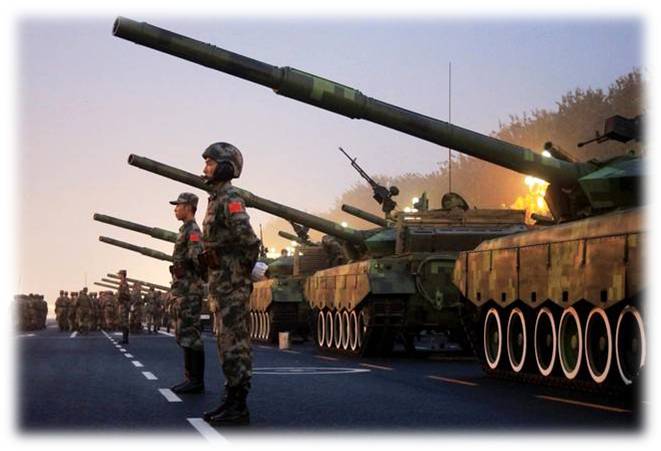
Chinese People’s Liberation Army Integrated Joint Operations
An interesting entry on China Defence Mashup provides a valuable overview of the military transformation process that is undergoing in China regarding the panning and conduct of Integrated Joint Operations (IJO).
The change from Joint Operations (JO) to Integrated Joint Operations (IJO) came about in the post 2002 era when the Chinese People’s Liberation Army (PLA) shifted the emphasis from local wars under hi-tech conditions to local wars under informationalised conditions.Read the Full Story
The concept of IJO incorporates various types of units (ground, air, naval, missiles and logistics) and battlefield systems (Communications, Intelligence, Surveillance, Reconnaissance and Electronic warfare) into operations while treating each element equally in planning and execution.
While the organisation tree for the conduct of IJO at the campaign level is not available in the open domain, the responsibility to frame and suggest structures was given to the Nanjing Army Command Academy in the aftermath of US operations in Iraq in 2003. The responsibility included preparation of a doctrine, modular groupings at each level, integrated logistics, joint training and exercises and a strategic project to develop talented personnel in information technology.
Contract Award: General Dynamics to maintain U.S. Army's Common Ground Station system
News Report
As announced in a recent press release, General Dynamics has been awarded a five-year, $47 million follow-on contract to update and maintain the operational readiness of all Common Ground Stations (CGS) for the U.S. Army. General Dynamics will provide the spare parts, assemblies, engineering support and other logistics needed to keep the CGS fleet technically current and fully operational worldwide.
The System
Common Ground Stations are deployed by U.S. Army to assist commanders in the collection, analysis and distribution of intelligence, surveillance and reconnaissance information gathered by airborne radar aircraft, unmanned aerial vehicles and other sensors.
The upgraded version of the system enables high quality imagery and video at ultra low bandwidth, directly to the soldier, providing multiple real time video feeds, Import/Export of all common imagery formats including NITF (National Imagery Transmission Format), and integrated transmit/receive imagery products across the network.
The Context
In 1996, the U.S. Army awarded the original Common Ground Station system contract to General Dynamics, ordering 102 systems. The first Common Ground Station was delivered to U.S. Army in 2000. In 2005, General Dynamics received the first contract to supply logistics and maintenance support for the fleet of Common Ground Stations.
Since 1996, General Dynamics' Common Ground Stations have been deployed in support of U.S. Forces operations, including Operation Iraqi Freedom, Operation Enduring Freedom, Global War on Terrorism, Bosnia/Kosovo, U.S. Forces Korea, and U.S. Forces Europe.
Comments
Mark Showah, director of Integrated Systems for General Dynamics C4 Systems, said, “This award reflects the continuing confidence our customer has in the system and the relevant capabilities it provides in support of vital Army and joint missions around the world.”
References: General Dynamics (1,2,3)
December 12, 2011
Lockheed Martin's Senior Scout delivered to U.S. Air Force
News Report
As reported in a recent press release, an airborne signals intelligence system configured specifically for the newest C-130J aircraft has been delivered to the U.S. Air Force by Lockheed Martin. The system, which is part of the Senior Scout program that enables C-130 aircraft to be used for tactical signals intelligence and reconnaissance, will undergo acceptance testing in December.
The System
The Senior Scout system is a radio signal monitoring sensor package carried by the C-130 Aircraft.
Senior Scout is an intelligence, surveillance and reconnaissance (ISR) system built into a trailer-like container that can be rolled on and off C-130 aircraft. This ISR suite of equipment rapidly configures standard C-130 aircraft for tactical signals intelligence, providing capabilities that exploit, geo-locate and report communications intelligence and signals of interest to air and ground component commanders.
Senior Scout operations may be long or short range missions with extended orbit delays planned at the aircraft operating ceiling, and may require one or multiple air refuelings. Some missions may require a combat profile, with a low altitude profile enroute to the mission orbit area. The electronic environment may be hostile, with enemy ability to jam all communications radios and electronic transmission systems; to intercept and use intelligence information transmitted over nonsecure electronic systems and radios; and to pinpoint the position of the aircraft emitting any electronic transmission or signal.
The Airborne Collection Electronic Signals II (ACES II) capsule accomodates from 4 to 12 operators of 2-MHz to VHF (COMINT) and 2-18 GHz (ELINT) bands.
The Context
Palletized shelters that can be rolled on and off cargo aircraft are an element of Lockheed Martin’s Dragon family of ISR configurations.
The latest Senior Scout shelter was enhanced to be structurally compatible with the newest C-130J aircraft. System interfaces were updated, and the shelter was equipped with the latest technology enhancements and improvements for maintenance access. The shelter also defines the design that will be used to upgrade the three legacy shelters over the next 24 months to ensure the entire Senior Scout fleet is C-130J compatible.
Comments
“We are honored to continue providing the Air Force with a modern, capable signals intelligence system,” said Jim Quinn, vice president of C4ISR Systems for Lockheed Martin IS&GS-Defense. “The latest shelter configuration advances the Senior Scout capability for the next generation of C-130J aircraft.”
References: Lockheed Martin (1), FAS.org (2)
Contract Award: Northrop Grumman to add Tactical Data Link technology on U.S. Army's "Hunter"
Background
Here in this blog we have already reported on the recent activities and programs focused on improving the level of integration of Unmanned Aerial Vehicles within military C4I systems (1,2,3).
In a first post published on November 2nd (Manned to Unmanned) we have discussed the results of the first ever Manned-Unmanned Systems Integration Capability exercise, which established seamless integration of Apache Block II and Kiowa Warrior helicopters, along with the U.S. Army's complete fleet of Unmanned Aircraft Systems (Raven, Puma, Hunter, Shadow and Gray Eagle). One of the objective of the exercise was to highlight the U.S. Program Executive Office Aviation's open architectural approach, that allows multiple control nodes and information access points to interoperate via the Tactical Common Data Link (TCDL).
In a second post published on November 3rd (Controlling the drones during the battle), we reported on the planned electronic enhancements to the AH-64D Block III, which includes advanced control of UAVs from inside the helicopter. By accessing the improved control suite (the so-called "tactical control data-link radio"), the pilot in the chopper can do everything but launch and land his drone: he can steer the UAV and its sensors and see everything it sees (for the delicate tasks of launching and landing, the pilot hands over control to an operator on the ground).
Finally, in the blog entry appeared on November 15th (U.S. Navy demonstrates UAV to Weapons interoperability through a Service Oriented Architecture) we reported that the U.S. Navy recently completed a demonstration for its unmanned aircraft Common Control System (CCS) at Naval Air Warfare Center Weapons Division in China Lake, Calif. During the demonstration, operators used the CCS to control a simulated unmanned aircraft system (UAS) and associated sensors tasked by Special Operations Forces. The UAS identified and tracked a hostile moving target and sent images of the target to an air controller. The UAS data created a precise coordinate so that a Net-Enabled Weapon (NEW) could strike. The UAS and NEW controller were then used together to perform a battle damage assessment.
News Report
In the above context, a recent press release announced that the U.S. Army has awarded Northrop Grumman two logistics support contract modifications, totaling $91.2 million, for the MQ-5B Hunter program, aimed at providing the platform with interoperable tactical common data link technology (TDCL).
Under the terms of the contract, Northrop Grumman will reset the current C-Band Hunter MQ-5B systems with TCDL technology to include resetting Hunter air vehicles, ground stations and data terminals with TCDL technology. Additionally, the TCDL also serves as a foundation of establishing interoperability among different U.S. Department of Defense air vehicles and ground stations. Such innovation also allows for manned aircraft to use unmanned aircraft, their sensors and weapons as an extension of their own capabilities keeping aviators out of harm's way.
The Technology
The Common Data Link denotes a family of full-duplex, asymmetric, jam-resistant, point-to-point microwave communication links developed by the U.S. back in the 1970s and used in imagery and signals intelligence (SIGINT) collection systems. TCDL is a narrow-band version of CDL but is evolving into a relatively low-cost, full-bandwidth version.
In the U.S., the TCDL program was introduced to provide a family of interoperable, secure, digital data links for use with both manned and unmanned airborne reconnaissance platforms. Rapid growth in the development of secure, digital TCDLs for use with both manned and unmanned airborne reconnaissance platforms, has tended to focus on ensuring interoperability and thus common standards for TCDL-equipped platforms in U.S. military service.
TDCL transceivers transmit and receive ISR data at rates from 1.544Mbps to at least 10.7 Mbps over ranges of 200 kilometers. TCDL will soon support the required higher CDL rates of 45, 137 and 274 Mbps.
The Context
MQ-5B Hunter is a multi-mission, medium altitude endurance tactical unmanned aerial system (UAS) optimized to provide U.S. Army division and corps commanders with a dedicated reconnaissance, surveillance, and target acquisition (RSTA) capability.
![]() |
| MQ-5B Hunter |
The MQ-5B conducts battlefield surveillance using its multi-mission optronic payload. Flying over the battlefield, it gathers RSTA and battle damage information in real time, then relays it via video link to commanders and soldiers on the ground. The payload also broadcasts its sensor data to ground control and mission monitoring stations, providing commanders with enhanced situation awareness and the ability to proactively plan and execute decisive combat operations. The MQ-5B Hunter is distinguished by its heavy fuel engine, its “wet” (fuel-carrying) extended center wing with weapons-capable hard points, and the most modern avionics suite in the DoD inventory.
The Hunter originated as a Joint Army/Navy/Marine Corps UAS program. It was terminated in 1996, but through the procurement of a limited number of Low Rate Initial Production (LRIP) systems, Hunter exists today. The modernization from the RQ-5A to the MQ-5B was initiated in FY04. Hunter deployed to Macedonia to support NATO Balkan operations in 1999 and to Iraq in 2002, where it continues to support combat operations today. The MQ-5B Hunter, which is currently deployed supporting contingency operations in Southwest Asia, is providing the U.S. Army with state-of-the-art intelligence, surveillance and reconnaissance, and communications relay. Hunter has accumulated more than 100,000 flight hours, approximately 80 percent of which are combat related.
Comments
"With additional Hunters fielded with TCDL, our nation's warfighters are further equipped with greater bandwidth and encryption, safeguarding vital information," said Kevin Goates, director, Northrop Grumman Technical Services' Unmanned Systems Sustainment Center.
"The Hunter was critical to development of numerous advanced manned and unmanned teaming concepts while attached to combat aviation brigades in support of operations in Iraq," said Goates. "Most importantly, it saved, and will continue to save, the lives of countless soldiers and civilians as it plays a vital role in overcoming the threat of improvised explosive devices."
References: C4I Technology News (1,2,3), Northrop Grumman (4,5), UAV Forum (6), ADM (7)
Subscribe to:
Posts (Atom)